- HOME
- Why Nightly Drinking Sticks
- Why Do I Drink Every Night
Why Do I Drink Every Night?

Written by Susan — Quit drinking at 37 • Sober since 1998 • Sharing what actually works
Written by Susan — Quit drinking at 37 • Sober since 1998 • Sharing what actually works
If you find yourself reaching for a drink at the same time every evening and quietly wondering, “why do I drink every night?” — you’re not alone, and you’re not lacking willpower. It can feel like something you should be able to control — something you’ve promised yourself you’ll change — and yet the same pattern keeps repeating.
✅ Quick Answer: Why do I drink every night?
Many people drink every night because their brain has linked evening time with relaxation, relief, or reward. Over time, this becomes an automatic habit triggered by routine — not a conscious decision. Understanding the habit loop, evening triggers, and why stopping feels so difficult is the first step toward breaking the cycle.
What feels like a personal weakness is often something far more predictable: a learned pattern your brain has quietly built over time.
By the time you reach the evening, your brain isn’t looking for discipline — it’s looking for relief.
After a full day of decisions, responsibilities, and mental effort, your brain shifts into energy-saving mode. That’s when habits take over.
If drinking has become your “default unwind,” your brain will keep steering you there — not because it’s the best choice, but because it’s the most familiar one.
And familiarity feels safe.
🎙️ Want to hear the podcast hosts’ take?
The podcast conversation explores this topic from another perspective.
Jump to the podcast episode.
Why Do I Drink Every Night? (What’s Really Going On)
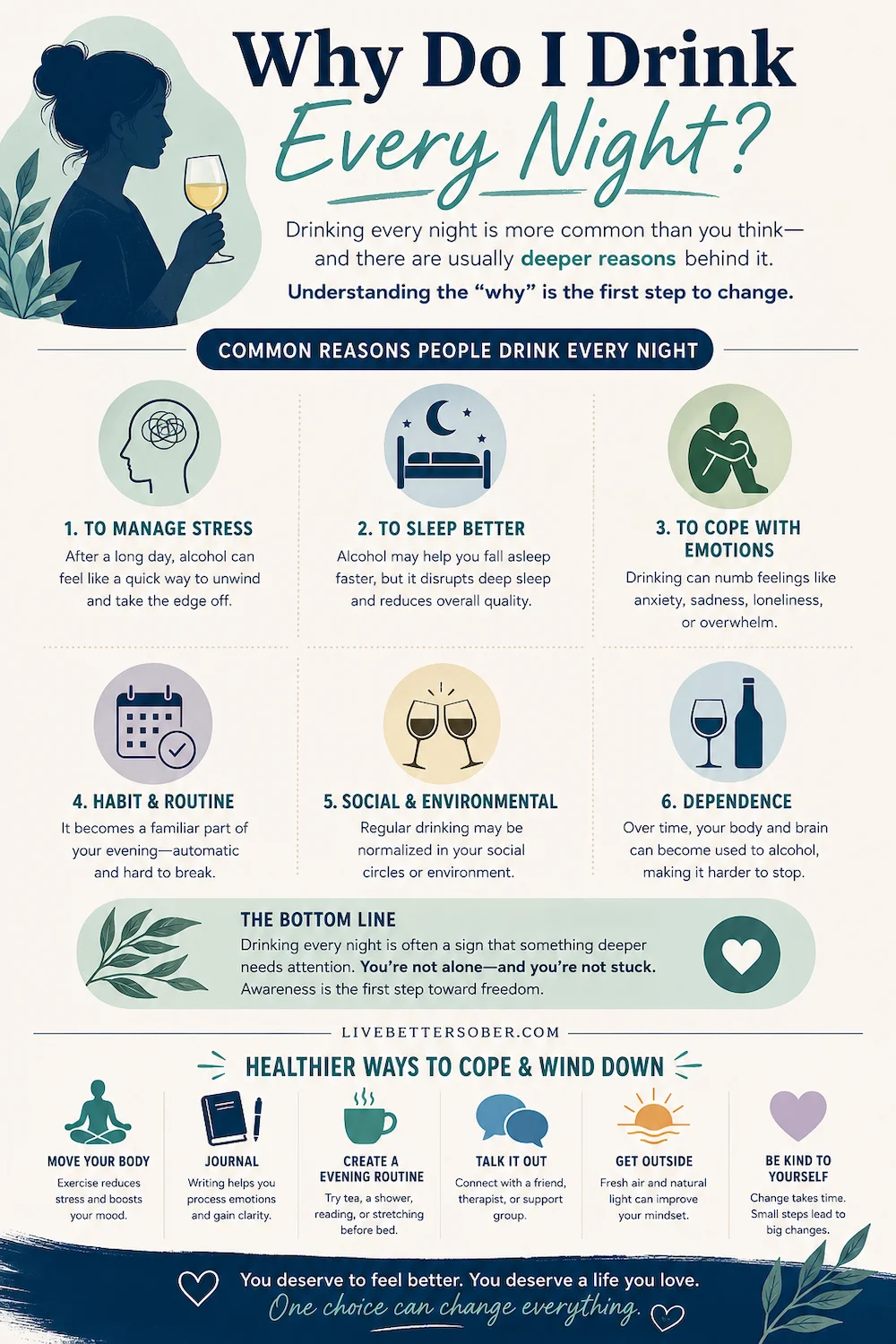
It can feel confusing. You tell yourself you’ll skip it tonight… and then somehow, almost without thinking, you’re pouring that same drink again. Not because you’re weak — but because your brain has linked evening time with relief, comfort, or reward.
Once you understand what’s really driving this habit, something shifts. The frustration starts to ease, and for the first time, it feels like something you can actually change.
It’s Not About Willpower
You may have blamed yourself:
- “Why can’t I just stop?”
- “What’s wrong with me?”
But nightly drinking isn’t a character flaw — it’s a conditioned response.
Willpower works in short bursts.
Habits, on the other hand, run automatically.
And by the time evening rolls around, your mental energy is already depleted from the day.
👉 That’s why this pattern shows up at night.
The Evening Trigger Is Stronger Than You Think
Evenings are powerful because they combine:
- routine
- environment
- emotion
All at once.
Your Brain Loves Predictability
If you’ve been drinking at roughly the same time each day, your brain starts to expect it.
Your Environment Reinforces It
Same chair. Same TV. Same kitchen.
These cues quietly signal: “It’s time.”
You’re Tired (and That Matters)
Decision-making gets weaker at the end of the day. That’s when habits take over.
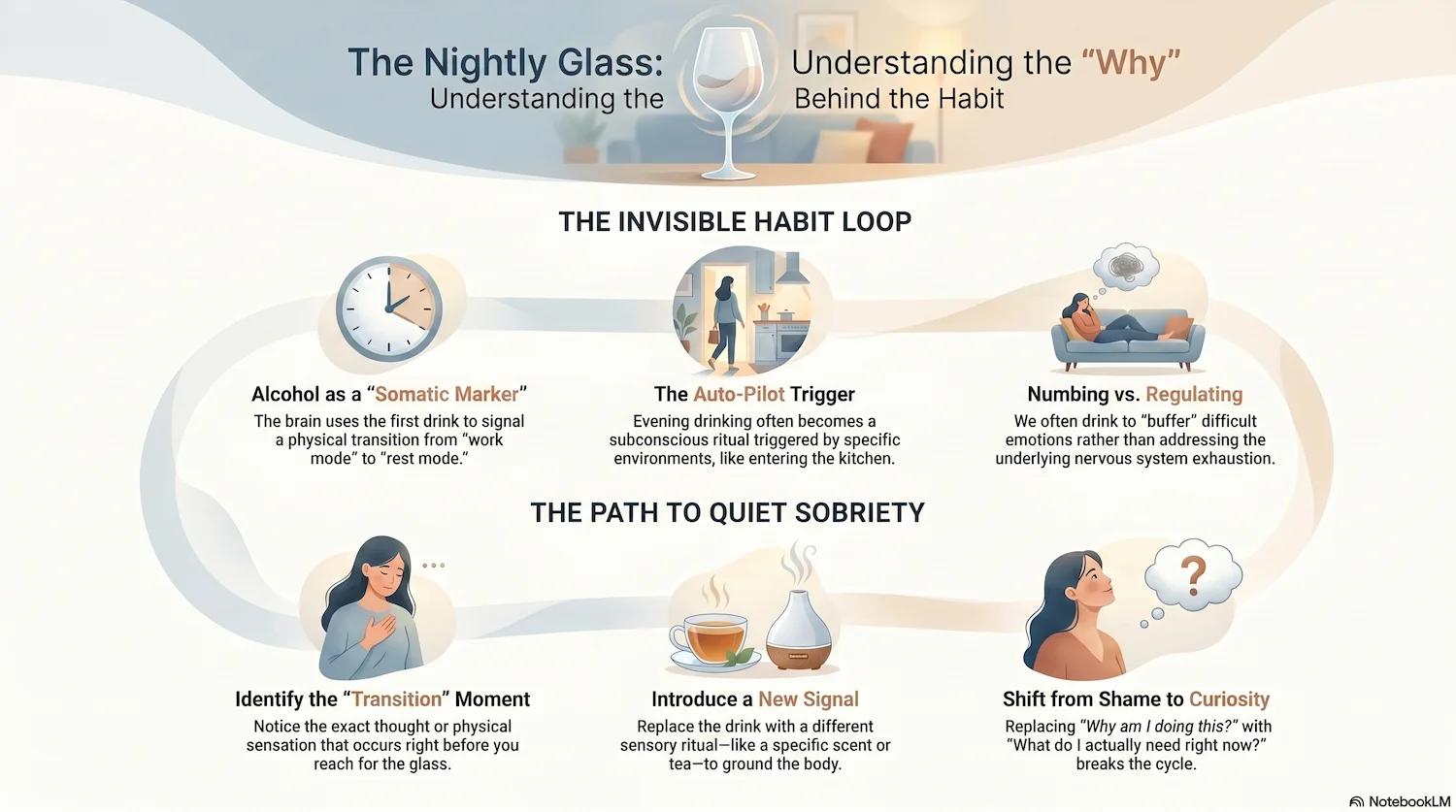
The Habit Loop Running in the Background
This pattern is often invisible, but it’s very real:
The more this repeats, the more automatic it becomes.
Eventually, it stops feeling like a choice.
Why Stopping Feels So Uncomfortable
This is the part many people don’t expect.
When you try to stop, it’s not just about skipping a drink.
You’re also removing:
- a transition from day → night
- a way to unwind
- something to look forward to
That’s why evenings can suddenly feel:
- flat
- restless
- incomplete
👉 That discomfort isn’t failure — it’s a gap that needs replacing.
This Is Actually Good News
If this is starting to make sense, the next step is understanding why it feels so hard to stop — even when you want to.
Here’s the shift:
If this habit was learned…
👉 it can be changed.
You don’t need to “try harder.”
You need to understand the pattern — and work with it.
And that’s where things start to get easier.
What to Do Tonight
The first step is simply recognizing that the drinking may have become automatic. Many nightly drinking habits run on autopilot — triggered by stress, routine, or the need to switch off at the end of the day. Once you can see the pattern clearly, it becomes much easier to begin changing it.
The next step is understanding why evenings feel especially difficult — and what’s happening in your brain and body when the urge shows up. Continue to:
Why Is It Hard to Stop Drinking at Night
You’re not stuck because you’re weak.
You’re stuck because this pattern has been quietly reinforced, day after day.
Once you start to see it clearly, something changes.
The habit stops feeling like a mystery — and starts looking like something you can actually take control of.
And that’s where real progress begins.
Want the Podcast Version of this Page?
Want to go deeper? The podcast version of this page explores these ideas in a more conversational and reflective way. You can listen to it below.
Understand the Habit More Deeply
The nightly drinking habit rarely comes down to just one thing. Stress, routines, emotional triggers, and automatic thought patterns often work together in ways that aren't obvious until you begin looking more closely.
If today's page resonated with you, the articles below can help you understand why nightly drinking sticks—and, more importantly, how those patterns can begin to change.
→ Explore all Why Nightly Drinking Sticks articles
Ready for More Support?
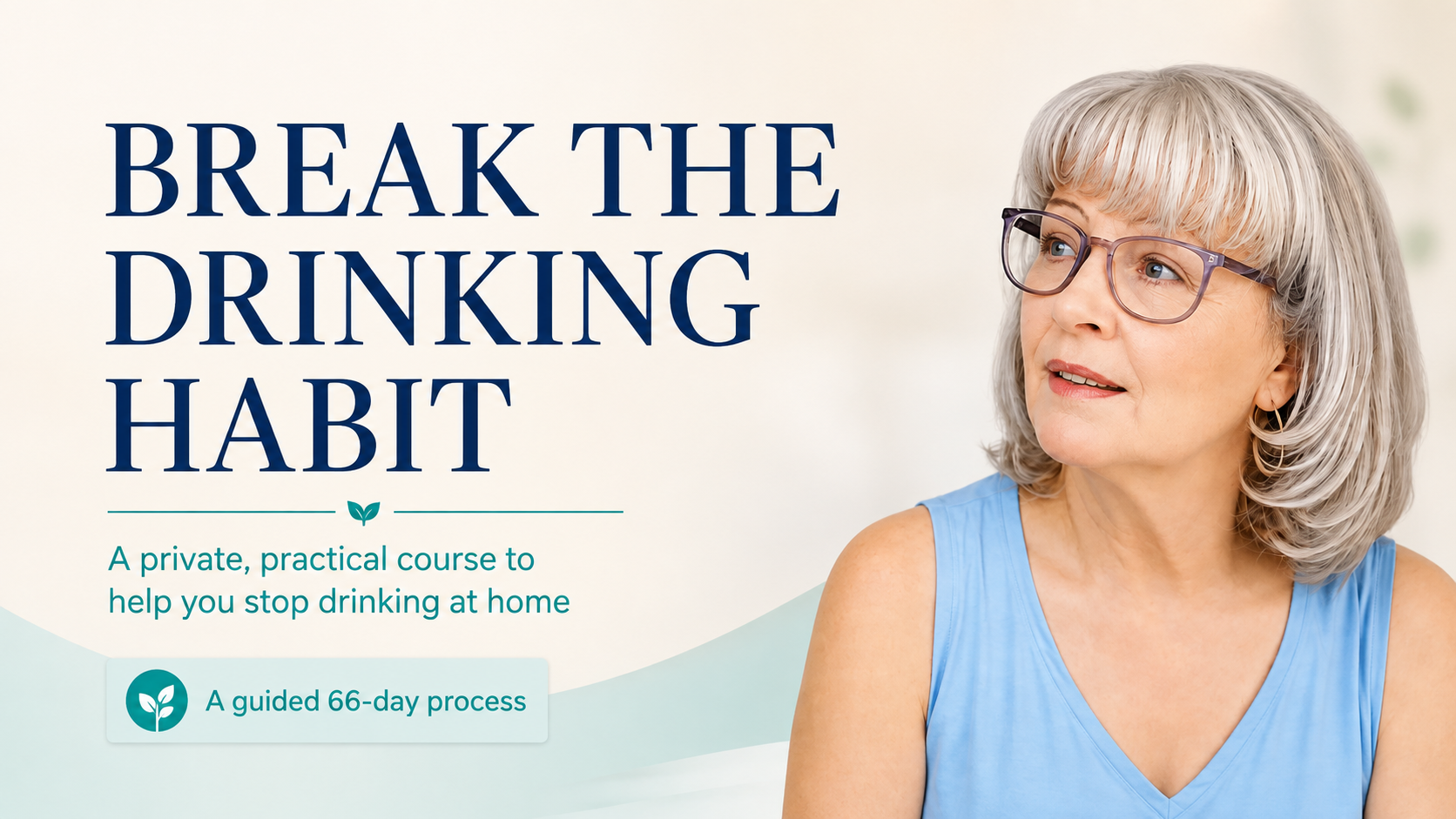
Explore Live Better Sober: Quit Drinking — Break the Alcohol Habit, a practical, shame-free 66-day course designed to help you recognize and interrupt the pattern behind your evening drinking.
➡️ Learn more about the course here: Break the Nightly Drinking Habit
Common Questions About Drinking Every Night
Is drinking every night a sign of a problem?
Is drinking every night a sign of a problem?
It can be — especially if it feels automatic or hard to stop. The key issue isn’t frequency alone, but whether it feels in control or out of your hands.
Why do I crave alcohol at the same time every evening?
Why do I crave alcohol at the same time every evening?
Because your brain has learned to associate that time of day with relief or reward. Over time, this becomes an automatic trigger.
Can this habit be broken?
Can this habit be broken?
Yes. Once you understand what’s driving it, you can start to replace the pattern in a way that actually works.
Why Nightly Drinking Sticks
Why Is It Hard to Stop Drinking at Night?
Why is it hard to stop drinking at night? Learn why evening drinking feels so difficult and how to change it.
Wine O'Clock Habit Loop Explained
Wine O'Clock Habit Loop patterns often feel automatic. Learn why they happen and how to interrupt the evening drinking cycle.
Drinking to Shut Off Thoughts: Why It Happens
Drinking to shut off thoughts can feel like relief in the moment. Learn why it happens and what to do instead tonight.
Reward Drinking After a Hard Day: Why It Sticks
Reward drinking after a hard day can become an automatic nightly habit. Learn why it happens and what to do instead.



I'm Susan, creator of Live Better Sober, and in January 2028 I'll celebrate 30 years alcohol-free.
Everything on this site comes from my own experience.
I hope that by sharing what I've learned, I can help you break the nightly drinking habit, rediscover yourself, and live better sober, too.
I'm Susan, creator of Live Better Sober, and in January 2028 I'll celebrate 30 years alcohol-free.
Everything on this site comes from my own experience.
I hope that by sharing what I've learned, I can help you break the nightly drinking habit, rediscover yourself, and live better sober, too.
Stay Connected with Live Better Sober
Get new articles, personal stories, podcasts, and practical ideas to help make sober evenings easier.
No lectures. No labels. Just useful support from someone who's been there.


NEWSLETTER
HOME ABOUT CONTACT DISCLAIMER PRIVACY TERMS
FOLLOW US ON:



|
|
|
|
|
SEARCH THIS SITE
LIVE BETTER SOBER IS BASED ON SUSAN GAST'S PERSONAL EXPERIENCE WITH QUITTING ALCOHOL AND LONG-TERM SOBRIETY.
ALL CONTENT COPYRIGHT © 2026 LIVE BETTER SOBER BY SUSAN GAST • ALL RIGHTS RESERVED REGARDLESS OF LINKS OR ATTRIBUTIONS.
POWERED BY SBI! (SOLO BUILD IT!)
