- HOME
- Restarting After a Slip
- Does Relapse Mean I Failed
Does Relapse Mean I Failed or Something Else?


Written by Susan — Quit drinking at 37 • Sober since 1998 • Sharing what actually works
Written by Susan — Quit drinking at 37 • Sober since 1998 • Sharing what actually works
If you’ve ever asked yourself, does relapse mean I failed, take a breath. A relapse can feel awful, especially when you were trying hard and meant what you said. But one slip does not erase your progress, your awareness, or your ability to choose differently next time.
✅ Quick Answer: Does relapse mean I failed?
No, relapse does not mean you failed. It means the cycle was not interrupted in that moment. What matters next is whether you use it as information, reset quickly, and keep moving forward.
🎙️ Want to hear the podcast hosts’ take?
The podcast conversation explores this topic from another perspective.
Jump to the podcast episode.
Does Relapse Mean I Failed?
It can feel that way in the moment — but that doesn’t make it true.
A relapse is not proof that you’re hopeless.
Or that you can’t change.
It is a signal that something in the drinking cycle still needs attention.
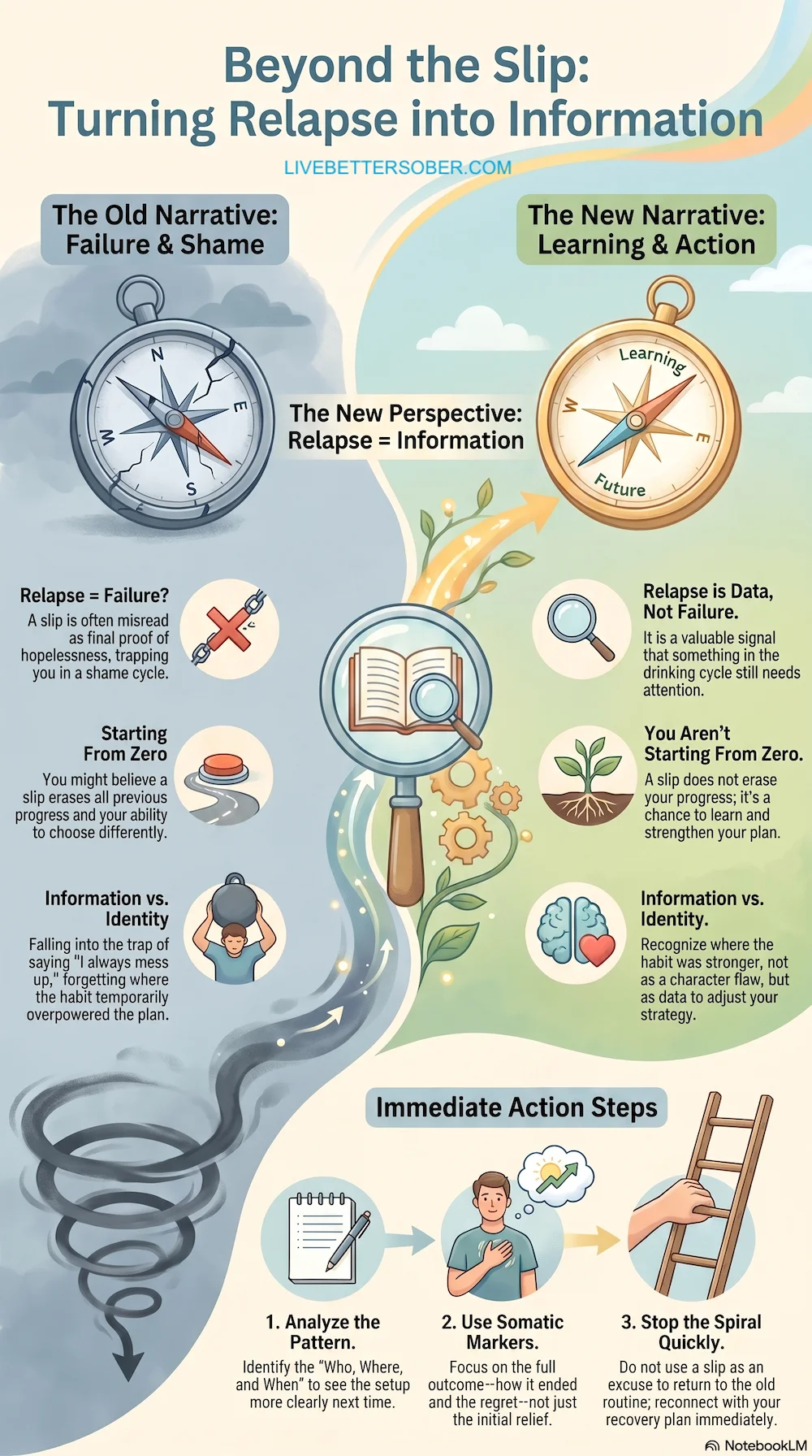
What To Do Immediately After a Relapse
If a slip-up occurs, you are not alone. My first attempt at sobriety lasted nine whole months before I slipped.
What you do next is the important part.
First, accept that it happened without turning it into a reason to give up. Try not to sit there beating yourself up for days. That only keeps the spiral going.
Instead, go back and remember the moments that made you want to quit drinking in the first place. Remind yourself how you felt, what alcohol was costing you, and why you wanted something different. That reconnects you with your real reason for stopping.
It also helps to look honestly at what happened.
Where were you?
Who were you with?
What were you feeling?
What did you tell yourself right before drinking?
Those details matter because patterns repeat.
The more clearly you can see the setup, the easier it becomes to step in earlier next time.
And in early sobriety, avoiding drinking environments is usually one of the smartest things you can do. That’s not rocket science, but it matters more than most people want to admit.
Relapse Is Information, Not Identity
One of the biggest mistakes people make after a relapse is turning it into an identity.
They say things like:
- “I always mess this up”
- “I knew I couldn’t do it”
- “What’s the point now?”
But relapse is not who you are.
It is information.
It shows you where the habit was stronger than your plan.
And once you know that, you can work with it.
Don’t Use Relapse as an Excuse to Keep Drinking
This is where honesty matters.
A relapse does not mean you failed.
But it also does not mean:
👉 “Oh well, I might as well keep drinking now.”
That is the old pattern trying to turn one slip into a full return to the routine.
The faster you stop that spiral, the better.
A slip is a moment.
It does not have to become a return to the whole routine.
Look at What Happened Without Beating Yourself Up

You don’t need shame.
You need information.
Ask yourself:
- What time was it?
- What was I feeling?
- What did I tell myself?
- What did I ignore?
- What could I do differently next time?
You don’t need shame.
You need information.
Ask yourself:
- What time was it?
- What was I feeling?
- What did I tell myself?
- What did I ignore?
- What could I do differently next time?
This is not about punishing yourself.
It is about understanding the pattern clearly enough to interrupt it earlier next time.
A relapse often reveals something important.
If it happened around the same time as before, that timing may still be a trigger.
If the same feeling showed up again, that emotion may still need a better response.
If the same excuse appeared in your thinking, that thought pattern probably needs challenging sooner.
And if the outcome keeps repeating, you probably need to step in earlier in the cycle.
This Is Where Somatic Markers Matter
This is another place where somatic markers become useful.
After a relapse, it is tempting to only remember the relief or the first part of drinking.
But that is not the whole story.
You need to remember the full outcome:
- how it actually ended
- how you felt afterward
- what you regretted
- what you promised yourself later
Those details matter.
They become part of the evidence your brain can refer back to later instead of only remembering the temporary relief.
Inside the course, I show you how to use somatic markers properly so they become a practical tool — not just another painful memory.
It Doesn't Mean You're Starting From Zero
This is important.
If you had several sober days and then slipped, those days still count.
You learned something.
You proved you could interrupt the routine for a while.
You learned where the weak spot still is.
That is not nothing.
That is progress with a lesson attached.
The Next Choice Matters Most
You cannot change the relapse after it happens.
But you can change what you do next.
That next choice matters.
Not because it suddenly makes everything perfect again, but because it stops the old pattern from taking over completely.
This is where personal responsibility comes back in.
You still get to choose what happens next.
And if you notice the urge building again later, it helps to have a plan ready before the drinking voice gets louder. That is exactly why I wrote What Do I Do When I Feel Like Drinking Again.
A relapse is painful, but it does not have to define you.
What matters is what you learn from it, how quickly you interrupt the spiral, and whether you choose to keep going.
You are not back at the beginning.
You are starting to see the cycle for what it is.
And that clarity gives you another chance to change the outcome.
Want the Podcast Version of this Page?
Want to go deeper? The podcast version of this page explores these ideas in a more conversational and reflective way. You can listen to it below.
Continue Exploring Restarting After a Slip
A slip doesn't erase the progress you've already made. These articles are here to help you put one difficult evening behind you, rebuild your confidence, and get back on track without shame or self-criticism.
→ Browse all Restarting After a Slip articles
Ready for More Support?
Explore Live Better Sober: Quit Drinking — Break the Alcohol Habit, a practical, shame-free 66-day course designed to help you recognize and interrupt the pattern behind your evening drinking.
➡️ Learn more about the course here: Break the Nightly Drinking Habit
Frequently Asked Questions About Relapse
Does relapse mean I failed?
Does relapse mean I failed?
No. It means the cycle was not interrupted in that moment. What matters is what you do next.
Should I start over after a relapse?
Should I start over after a relapse?
A relapse does not erase the progress you already made. You still learned things about yourself, your triggers, and your drinking habits. The important thing is to keep going instead of turning one slip into a reason to give up completely.
How do I stop one relapse from turning into more drinking?
How do I stop one relapse from turning into more drinking?
Stop the spiral quickly. Look at what happened, learn from it, and make the next choice immediately.
Restarting After a Slip
Anxiety After Drinking — Why It Feels So Bad
Anxiety after drinking can feel overwhelming, shaky, and emotional. Here’s why it happens.
I'm Susan, creator of Live Better Sober, and in January 2028 I'll celebrate 30 years alcohol-free.
Everything on this site comes from my own experience.
I hope that by sharing what I've learned, I can help you break the nightly drinking habit, rediscover yourself, and live better sober, too.
I'm Susan, creator of Live Better Sober, and in January 2028 I'll celebrate 30 years alcohol-free.
Everything on this site comes from my own experience.
I hope that by sharing what I've learned, I can help you break the nightly drinking habit, rediscover yourself, and live better sober, too.
Stay Connected with Live Better Sober
Get new articles, personal stories, podcasts, and practical ideas to help make sober evenings easier.
No lectures. No labels. Just useful support from someone who's been there.


NEWSLETTER
HOME ABOUT CONTACT DISCLAIMER PRIVACY TERMS
FOLLOW US ON:



|
|
|
|
|
SEARCH THIS SITE
LIVE BETTER SOBER IS BASED ON SUSAN GAST'S PERSONAL EXPERIENCE WITH QUITTING ALCOHOL AND LONG-TERM SOBRIETY.
ALL CONTENT COPYRIGHT © 2026 LIVE BETTER SOBER BY SUSAN GAST • ALL RIGHTS RESERVED REGARDLESS OF LINKS OR ATTRIBUTIONS.
POWERED BY SBI! (SOLO BUILD IT!)
