- HOME
- Why Relapse Keeps Happening
- Why You Relapse at the Same Time
Why Do I Relapse at the Same Time Again?

Written by Susan — Quit drinking at 37 • Sober since 1998 • Sharing what actually works
Written by Susan — Quit drinking at 37 • Sober since 1998 • Sharing what actually works
If you’ve ever found yourself wondering why do I relapse at the same time, you’re not imagining it. It might be Day 7, Day 10, or even a specific time in the evening — and no matter how good your intentions are earlier in the day, the same moment seems to come back around and catch you off guard.
✅ Quick Answer: Why do I relapse at the same time?
You relapse at the same time because your brain has linked specific moments, emotions, and routines together. These repeated patterns become predictable triggers that lead to the same outcome unless they are interrupted.
🎙️ Want to hear the podcast hosts’ take?
The podcast conversation explores this topic from another perspective.
Jump to the podcast episode.
Why You Relapse at the Same Time Again
So why does this keep happening, even when you don’t want it to?
It usually isn’t one big moment. It’s often a build-up.
The same time of day arrives. The same feelings show up. And without really noticing, your brain starts following a familiar sequence it already knows.
And that’s where the ingrained sequence begins to take over.
Your brain thinks it’s helping you. A part of the brain called the basal ganglia stores routines and habits so you don’t have to consciously think about them every time.
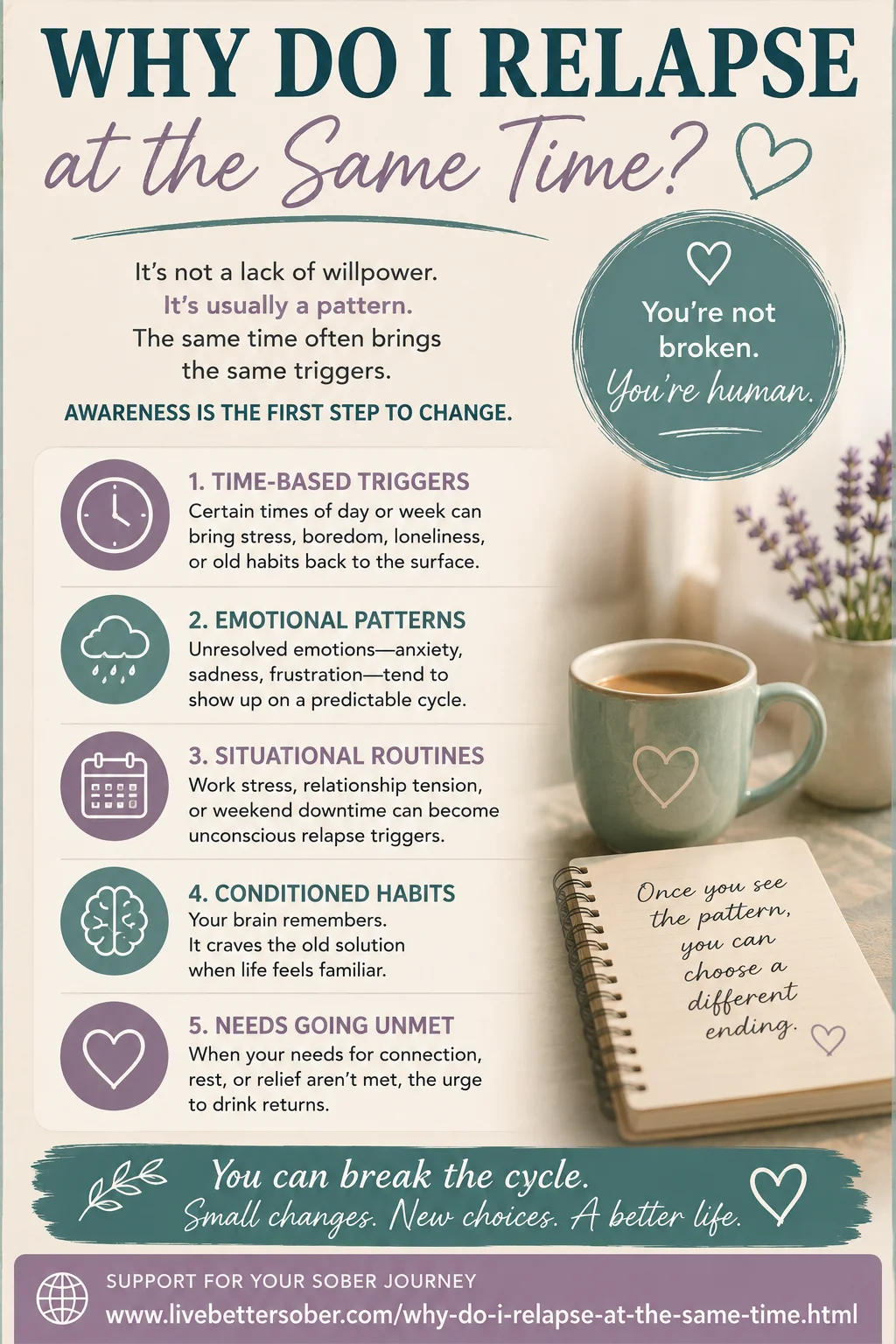
It’s Not Random — It’s Routine
This is one of the most important shifts to understand.
Relapsing at the same time isn’t bad luck.
It isn’t a sign that you’re failing.
👉 It’s a cycle repeating itself under the same conditions.
Your brain has learned to associate certain:
- times of day
- emotional states
- routines
with drinking.
So when those same conditions show up, your brain follows the same path.
Why Timing Matters More Than You Think
Many people focus on what they’re doing.
But the real driver is often when it happens.
You might notice:
- evenings feel harder than mornings
- weekends feel different than weekdays
- certain days (like Day 7 or Day 10) feel more difficult
👉 That’s not coincidence
It’s conditioning.
Your brain is anticipating the same reward at the same time.
What This Often Looks Like for Women
You've put in a full day at the office (whether away or at home). If you've got kids, you've had to take them to school - pick them up. At the end of the day, your decision-making part of the brain (the prefrontal cortex) becomes overloaded after making umpteen decisions all day.
To relieve tension, a glass of wine (or two) dampens anxiety and exhaustion. We drop into the "I deserve this" way of thinking. Before you know it, it's become your nightly routine.
The Build-Up Happens Before You Notice It
What makes this tricky is that the process often starts before you’re aware of it.
You might feel:
- slightly restless
- a bit unsettled
- quietly bored
Nothing dramatic.
But those small shifts are enough to start the autopilot response.
Then the thought appears.
👉 It almost feels expected
This Is Where Most People Get Caught

By the time you’re aware of what’s happening, you’re already in the moment.
That’s why relying on willpower feels so hard.
You’re trying to make a decision after the familiar path has already started.
This Is Where Somatic Markers Come In
This is the part most people never learn.
Instead of trying to fight the urge in the exact moment it appears, you can prepare for it in advance. That’s where somatic markers come in.
If you’re curious about the science behind this, you can read more about the somatic marker hypothesis here. But you don’t need to fully understand the neuroscience yet. What matters is this: somatic markers give you something real to refer back to when that moment arrives — something grounded in your own experience, not just willpower.
Even though relapse can feel like it happens “out of nowhere,” it usually doesn’t. The cycle has often been building quietly through repetition, timing, and expectation long before you consciously notice it happening. By the time the urge feels obvious, your brain has already started moving toward the same recognizable outcome.
That’s why awareness alone is not always enough. You need something that interrupts the sequence before it fully takes over.
And this is where things begin to change.
Once you start recognizing when the urge appears, how it builds, and what it usually leads to, you stop reacting blindly to the moment. You begin anticipating it instead. And when you can anticipate it, you have a much greater chance of changing what happens next.
Inside the course, you’ll learn exactly what somatic markers are and how to use them properly — so when that time shows up, you’re ready for it.
This Is the Turning Point
There’s a big difference between:
-
being surprised by the moment
and - seeing it coming
One keeps you stuck.
The other gives you a chance to do something different.
What to Do When You Reach Your Trigger Time
This is where you have to interrupt the routine. As soon as your hand lands on the refrigerator door to retrieve the wine bottle, you must interrupt that sequence.
Some people use the technique of pressing hard with a finger into their hand to create an internal "trigger" — right then and there — and train themselves to do that so they break the autopilot response.
This is also the best time for using one of your somatic marker moments.
When you find yourself in that moment where you know the inevitable drink lands in your hand, use the finger/hand trigger or — my favorite — use one of your best somatic marker moments to remind yourself why you don't want to do this anymore.
Relapsing at the Same Time Does Not Mean You’ve Failed
If you find yourself relapsing after the same number of days, or after the same length of time, it does not mean you've failed. It means you need to strengthen the reasons you no longer want alcohol running your life.
The old neural pathways haven't been "overwritten" yet. It takes time to quash the urges.
If you’re starting to see how this cycle plays out, the next step is knowing what to do in that moment when the urge shows up.
👉 What Do I Do When I Feel Like Drinking Again?
You’re not relapsing at the same time because you’re weak. You’re relapsing at the same time because your brain has been conditioned — and it’s repeating the action.
Once you understand that, the frustration starts to lift. And once the frustration lifts, you’re in a much better position to change what happens next — and that changes everything moving forward.
Want the Podcast Version of this Page?
Want to go deeper? The podcast version of this page explores these ideas in a more conversational and reflective way. You can listen to it below.
Continue Exploring Why Relapse Keeps Happening
If you've stopped drinking before but found yourself slipping back into old habits, you're not alone. These articles explore why relapse happens, what you can learn from it, and how to move forward with greater confidence and self-understanding.
→ Browse all Why Relapse Keeps Happening articles
Ready for More Support?
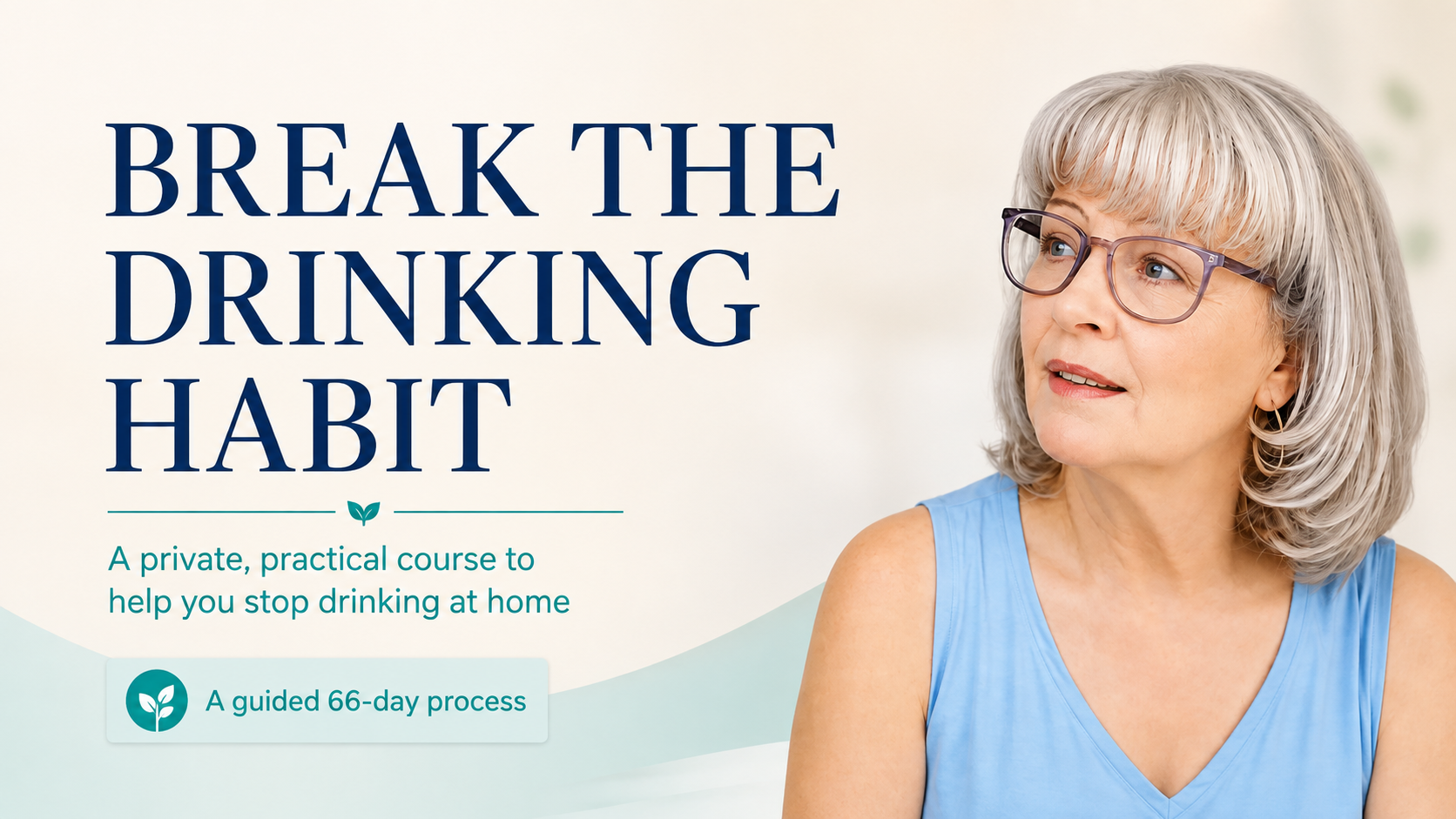
Explore Live Better Sober: Quit Drinking — Break the Alcohol Habit, a practical, shame-free 66-day course designed to help you recognize and interrupt the pattern behind your evening drinking.
➡️ Learn more about the course here: Break the Nightly Drinking Habit
Frequently Asked Questions
Why do I relapse at the same time every night?
Why do I relapse at the same time every night?
Because your brain has linked that time with a repeated routine and expected reward.
Is this just a lack of willpower?
Is this just a lack of willpower?
No. It’s a learned cycle that becomes automatic over time.
Can I stop this pattern from happening?
Can I stop this pattern from happening?
Yes. Once you recognize the timing and prepare for it, you can interrupt the cycle and respond differently.
Why Relapse Keeps Happening
Why Do I Keep Going Back to Drinking Again?
Why do I keep going back to drinking? Understand why this pattern repeats and what’s really going on.
Why Do I Keep Drinking Again on Day Three?
Why do you keep drinking again on Day Three? Understand the repeating pattern, the “just one” thought, and how to prepare before it returns.
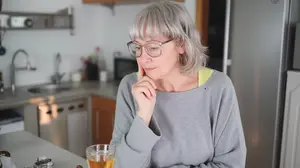

I'm Susan, creator of Live Better Sober, and in January 2028 I'll celebrate 30 years alcohol-free.
Everything on this site comes from my own experience.
I hope that by sharing what I've learned, I can help you break the nightly drinking habit, rediscover yourself, and live better sober, too.
I'm Susan, creator of Live Better Sober, and in January 2028 I'll celebrate 30 years alcohol-free.
Everything on this site comes from my own experience.
I hope that by sharing what I've learned, I can help you break the nightly drinking habit, rediscover yourself, and live better sober, too.
Stay Connected with Live Better Sober
Get new articles, personal stories, podcasts, and practical ideas to help make sober evenings easier.
No lectures. No labels. Just useful support from someone who's been there.


NEWSLETTER
HOME ABOUT CONTACT DISCLAIMER PRIVACY TERMS
FOLLOW US ON:



|
|
|
|
|
SEARCH THIS SITE
LIVE BETTER SOBER IS BASED ON SUSAN GAST'S PERSONAL EXPERIENCE WITH QUITTING ALCOHOL AND LONG-TERM SOBRIETY.
ALL CONTENT COPYRIGHT © 2026 LIVE BETTER SOBER BY SUSAN GAST • ALL RIGHTS RESERVED REGARDLESS OF LINKS OR ATTRIBUTIONS.
POWERED BY SBI! (SOLO BUILD IT!)
