- HOME
- Susan's Stories
- Drinking and Sports
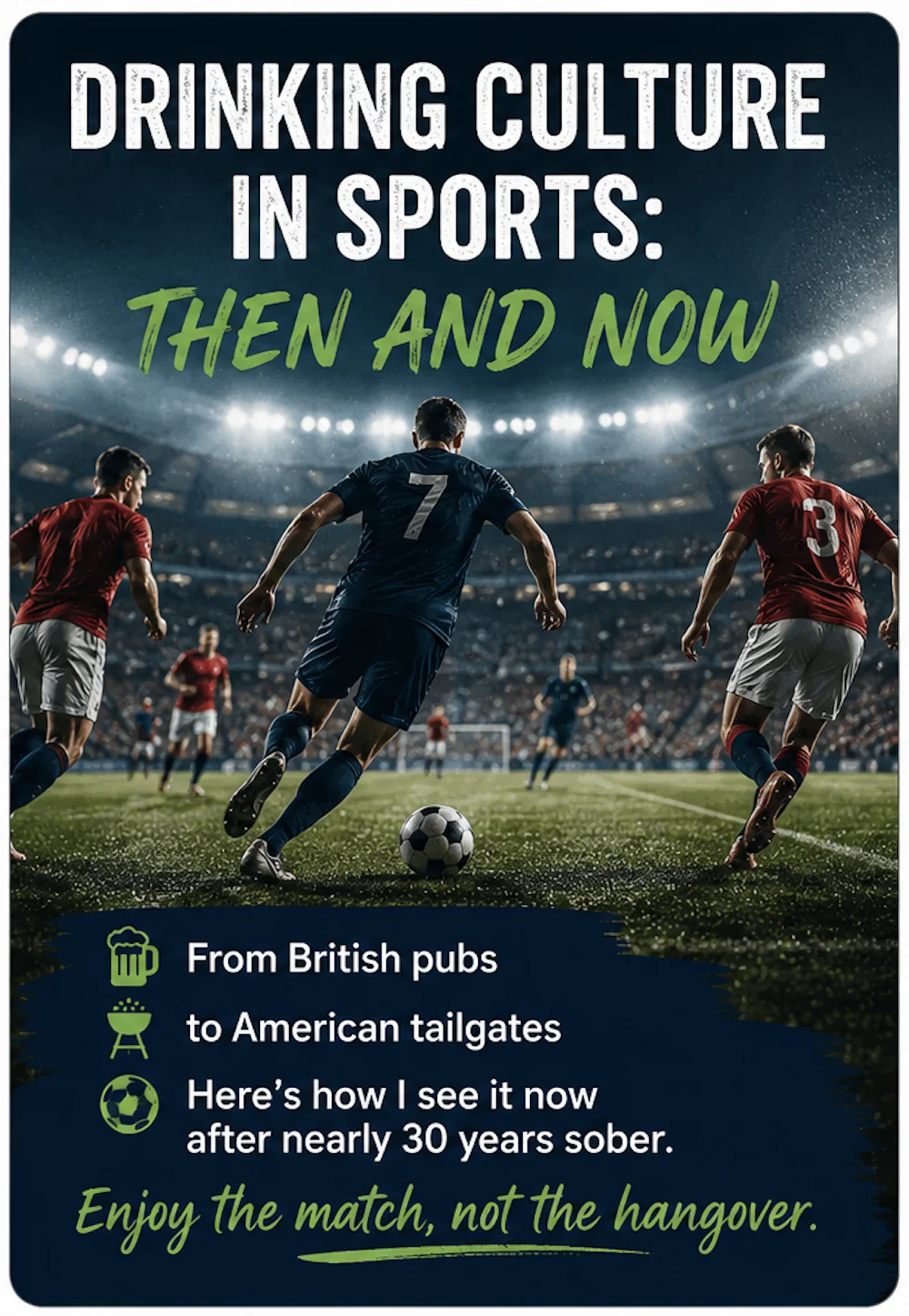
Drinking Culture in Sports: Then and Now


Written by Susan — Quit drinking at 37 • Sober since 1998 • Sharing what actually works
Written by Susan — Quit drinking at 37 • Sober since 1998 • Sharing what actually works
Drinking culture in sports has been around for generations. Whether it's football supporters gathering in British pubs before kickoff or American fans tailgating outside the stadium, alcohol has often become part of the tradition rather than the game itself.
Watching the World Cup reminded me just how normal all of that once seemed — and how differently I see it now after nearly three decades of sobriety.
✅ Quick Answer: Why do sports and drinking seem to go hand in hand?
Whether it's British football supporters meeting in pubs before kickoff or American fans gathering for tailgate parties, alcohol often becomes part of the event rather than the sport itself. Looking back after nearly three decades sober, I see those traditions very differently.
Football, Soccer... Whatever You Call It
For years I joked that every time I called football "soccer," I was betraying my British roots.
Then I discovered something that completely ruined my argument.
The word soccer actually came from England.
Long before Americans adopted it, British university students were using "soccer" as a nickname for Association Football to distinguish it from Rugby Football. Only much later did "football" become the overwhelmingly preferred term throughout Britain.
So perhaps I've been giving Americans a hard time for using a perfectly British word all along.
With the World Cup in full swing, though, it reminded me of something else that has always surrounded the beautiful game...
The drinking.
Growing up in England, football and the pub seemed inseparable. After moving to America, I discovered that although the traditions were different, the drinking culture wasn't all that different at all.
My First Proper Football Match
Before I left England for America in 1980, I'd only been to one proper football match. I practically begged my dad to let me go with my older brother and his mates. The match was Preston North End versus Blackburn Rovers, and to me it felt like a huge occasion.
Dad wasn't convinced.
"What about all the drinking and swearing?" he asked.
Without missing a beat, my brother replied, "Don't worry, Dad — we'll ignore her!"
That was my brother all over. Looking back now, though, Dad's concern wasn't really about football. It was everything that surrounded it.
From British Pubs to American Tailgates
What fascinates me now, living in the States, is how different the drinking traditions look on the surface.
British football fans hit the pub first, then the game.
In America, the drinking often starts at sunrise in a stadium parking lot.
They call it tailgating — a grand tradition where fans set up grills, play drinking games, and make an entire day of it long before kickoff.
In England, you cram into a crowded pub, standing shoulder to shoulder with a pint in your hand.
In America, you're relaxing in a camping chair, flipping burgers, tossing cornhole bags, and chatting with friends.
The drinks are different too.
English fans traditionally drink pints of bitter or lager.
American football fans might have beer, Bloody Marys, cocktails in red Solo cups, or just about anything else.
Different traditions.
Different food.
Different drinks.
Yet alcohol still seems to occupy exactly the same place in both cultures.
It's treated as though it's simply part of the sporting experience.
When Alcohol Turns Sport Into Something Else
Now, about that rivalry.
The long-running feud between Preston North End and Blackpool is legendary — and not for the football.
Over the years, tensions between supporters became so intense that the police often had to step in. I remember reading about hundreds of fans clashing outside Blackpool's stadium. What should have been ninety minutes of football became absolute mayhem.
Alcohol rarely helped.
So many supporters spent hours drinking before kickoff that the authorities eventually moved these fixtures to earlier in the day, hoping fewer pints would mean fewer problems. The pubs weren't exactly delighted, but there wasn't much they could do about it.
Well... almost.
One enterprising landlord decided to lock everyone inside after the official closing time so his customers could carry on drinking in secret. It worked for a while — until one rather worse-for-wear customer climbed out of the bathroom window and landed face-first on the pavement outside. It didn't take long for the police to work out what had been going on.
Even inside the stadium, things could become heated. Rival supporters were eventually separated by fences because football passion, mixed with alcohol and old rivalries, was proving to be a dangerous combination.
Looking back now, I see those stories differently.
At the time, they were told as funny tales or part of football folklore. Today, they remind me how easily alcohol can change the atmosphere around something that should simply bring people together. The match was never the real problem. Too often, it was what happened before the first whistle ever blew.
Philadelphia Reminded Me It Isn't Just Britain
After I first shared this story, my friend Lyndsay and her husband Wally added another perspective from Philadelphia.
Philadelphia sports fans are a breed of their own — passionate, intense and, let's be honest, sometimes a little terrifying.
Sure, the U.S. doesn't see the same level of organized hooliganism as parts of Europe, but don't be fooled. Sporting events here can still turn into all-out brawls, especially when rival teams are involved.
Philly, in particular, has earned a reputation for some of the toughest fans in the country. The Eagles' stadium even had a courtroom and judge in the basement for years to deal with game-day incidents.
When the Eagles won the championship, fans didn't simply celebrate. Parts of downtown were left looking as though a hurricane of green jerseys and beer cans had swept through.
As Wally pointed out, the game itself has changed too. Between soaring ticket prices, alcohol-fueled behavior and increasingly aggressive fans, attending games simply isn't as enjoyable as it once was.
Even Philadelphia's famous story about fans booing Santa Claus has become part of sporting folklore.
Different country.
Same lesson.
Alcohol can quickly become part of the spectacle instead of simply watching the game.
Looking Back With Sober Eyes
One of the unexpected gifts of nearly thirty years of sobriety is perspective.
When I was drinking, I never questioned why alcohol seemed to be everywhere whenever people gathered to watch sport. It simply felt normal.
Today, I notice something entirely different.
The football never needed alcohol.
The friendships didn't need alcohol.
The excitement didn't need alcohol.
Only the habit did.
Sometimes we don't realize how deeply drinking has become woven into everyday life until we're no longer taking part in it ourselves.
Enjoy the Match — Not the Hangover
These days I'm perfectly happy watching Preston North End and the World Cup matches from the comfort of my own sofa.
No packed pub.
No pushing through crowds.
No wondering whether someone has had one drink too many.
And certainly no waking up the next morning trying to remember what happened after halftime.
The older I get, the more I realize I never really needed alcohol to enjoy football.
I loved the game.
It just took nearly three decades of sobriety for me to separate the football from the drinking culture that had quietly attached itself to it.
And that's a match I'm happy to say sobriety finally won.
Continue Reading Susan's Story
If this story resonated with you, you may enjoy reading more about my own journey from nightly drinking to lasting sobriety. Each story shares a different lesson, challenge, or turning point that helped me build the alcohol-free life I have today.
→ Browse all of Susan's Stories
Ready for More Support?
Explore Live Better Sober: Quit Drinking — Break the Alcohol Habit, a practical, shame-free 66-day course designed to help you recognize and interrupt the pattern behind your evening drinking.
➡️ Learn more about the course here: Break the Nightly Drinking Habit

Frequently Asked Questions
Why is alcohol so connected to sporting events?
Why is alcohol so connected to sporting events?
Many sporting traditions evolved alongside pubs, bars, and social gatherings, making alcohol feel like a natural part of watching the game even though it isn't necessary to enjoy it.
Can you enjoy sports without drinking?
Can you enjoy sports without drinking?
Absolutely. Many people discover they enjoy the game even more because they remember it clearly, stay engaged throughout the match, and wake up without a hangover.
Is drinking part of football culture everywhere?
Is drinking part of football culture everywhere?
Different countries celebrate differently, but many sporting cultures have historically included alcohol as part of the social experience. That tradition is changing as more people choose alcohol-free ways to enjoy the game.
Susan's Stories
I Drank Because I Was Shy - Looking Back After 30 Years
I drank because I was shy—or so I thought. Looking back, I can see there were many reasons alcohol became my confidence crutch.
Why I Stopped Drinking at 37 - The Wake-Up Call I Needed
Why I stopped drinking at 37 began with a frightening wake-up call that finally convinced me I never wanted alcohol in my life again.
The Drunk Version Wasn't the Real Me After All
Drunk version wasn't the real me. Looking back, I can see alcohol often hid my true personality instead of revealing it.
Drinking Alone Meant Nobody Saw It Getting Worse
Drinking alone felt safer because nobody saw it. Looking back, Susan realized privacy gave her nightly drinking habit room to quietly grow.

I'm Susan, creator of Live Better Sober, and in January 2028 I'll celebrate 30 years alcohol-free.
Everything on this site comes from my own experience.
I hope that by sharing what I've learned, I can help you break the nightly drinking habit, rediscover yourself, and live better sober, too.
I'm Susan, creator of Live Better Sober, and in January 2028 I'll celebrate 30 years alcohol-free.
Everything on this site comes from my own experience.
I hope that by sharing what I've learned, I can help you break the nightly drinking habit, rediscover yourself, and live better sober, too.
Stay Connected with Live Better Sober
Get new articles, personal stories, podcasts, and practical ideas to help make sober evenings easier.
No lectures. No labels. Just useful support from someone who's been there.


NEWSLETTER
HOME ABOUT CONTACT DISCLAIMER PRIVACY TERMS
FOLLOW US ON:



|
|
|
|
|
SEARCH THIS SITE
LIVE BETTER SOBER IS BASED ON SUSAN GAST'S PERSONAL EXPERIENCE WITH QUITTING ALCOHOL AND LONG-TERM SOBRIETY.
ALL CONTENT COPYRIGHT © 2026 LIVE BETTER SOBER BY SUSAN GAST • ALL RIGHTS RESERVED REGARDLESS OF LINKS OR ATTRIBUTIONS.
POWERED BY SBI! (SOLO BUILD IT!)
