- HOME
- Why Nightly Drinking Sticks
- Shut Off Thoughts
Drinking to Shut Off Thoughts: Why It Happens


Written by Susan — Quit drinking at 37 • Sober since 1998 • Sharing what actually works
Written by Susan — Quit drinking at 37 • Sober since 1998 • Sharing what actually works
Drinking to shut off thoughts is something many nightly drinkers quietly relate to. When your mind feels full of worries, overthinking, regrets, responsibilities, or endless mental chatter, alcohol can seem like a fast way to create relief.
For a few hours it may feel as though the noise has faded. But for many people, the thoughts eventually return — often bringing anxiety, guilt, or frustration with them.
Understanding why this happens is an important step toward breaking the pattern.
✅ Quick Answer: Why am I drinking to shut off thoughts?
Drinking to shut off thoughts may feel helpful because alcohol temporarily dulls awareness of stress, anxiety, and mental chatter. The relief is usually short-lived, however, and many people find the thoughts return later along with additional problems such as poor sleep, anxiety, or stronger urges to drink again.
🎙️ Want to hear the podcast hosts’ take?
The podcast conversation explores this topic from another perspective.
Jump to the podcast episode.
Why Alcohol Feels Like It Shuts Off Your Thoughts
When you're feeling tired, stressed, or plain fed up, it's easy to turn to alcohol's numbing effect to blur the edges. And while it might take care of the problem for an hour, in reality, the stress is still there, lurking in the background.
If I knew then what I know now...
If I could tell "younger drinking me" that drowning your sorrows and drinking to shut off thoughts would work, I'd be happy to say that. In hindsight, drinking away your woes tends to make matters worse.
Waking up the following morning and finding the previous day's stressors are still there is demoralizing, to say the least. So that very night, you drink again in an attempt to shut down those racing thoughts. And so the cycle continues.
People drink to take their cares away, but their angst is still there the next day, often compounded by a headache, a bad attitude, and disappointment because they drank again.
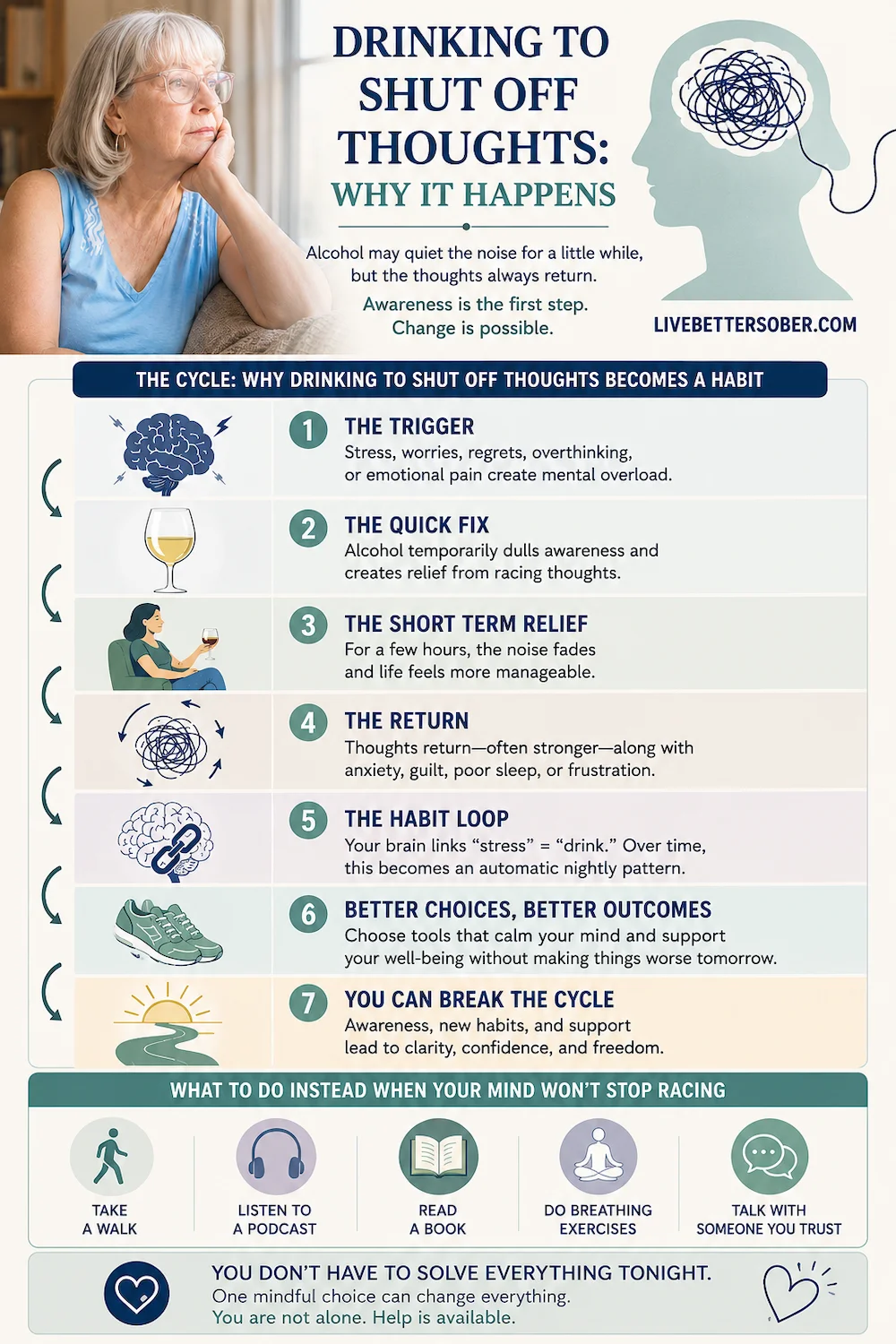
Why Drinking to Shut Off Thoughts Becomes a Habit
In my Wine O'Clock Habit page, I talk about how the brain believes it's helping us when it creates "associations" as a way to reduce decision-making.
Once your brain sees that you're doing the same thing every night, i.e. "worrying about paying a past-due bill" and then using alcohol to ease the worry, it thinks that after a few beers, you've forgotten about it.
Tomorrow night rolls around and that same "past-due bill" looms large. Again, you take care of the worry by popping a few beers and "pouff" — the fear around it fades.
When we continue doing that, our brain links "bill worries" = "drink beer" and all will be well.
Of course, this is only an example of how the habit takes hold. Alcohol's numbing effect takes care of the pain, but only temporarily.
What Are You Really Trying to Escape?
You do not need me to tell you that life can be tough and unfair. It hits you whether you're drunk or sober.
I know the urge to drink can be brought on by many factors and underlying issues. The anxiety of trying to fit in, loneliness caused by living alone, or the uncertainty of what the future holds.
Self-criticism was a big thing for me. If something went wrong at work, I'd get home and think, "Oh, what the heck. I screwed that up. I can't do anything right." Once that seed germinates, look out. The pity-party begins, and beer to the rescue. I thought it would cheer me up and numb the pain of feeling inadequate. And then I would end up saying to myself, "who cares about me anyway?"
You have a choice to make: Are you drinking because you're trying to escape or are you drinking because it's "what you do" at night? There's no right answer. But if you're using alcohol to de-stress, just know that drinking doesn't fix the problem. It never will — it never did for me.
The Problem With Using Alcohol as a Mental Off-Switch
Looking back over my 20-year drinking stint, using alcohol to lessen stress only led to more anxiety, poor sleep, and a loss of self-trust. The original thoughts and problems weren't washed away by a sea of alcohol. They were just harder to identify with a fuzzy mind.
As always, the problems returned the very next day. Unresolved, and gaining ground.
I also realize now that most of the issues were compounded by drinking. Take the work example earlier. If I messed up and tried to fix it with a foggy hangover the day after, I wasn't doing myself any favors or the company I worked for. Both of us deserved better.
How The Somatic Marker Method Explains the Pattern
I'd reached my turning point at age 37. I knew I had to quit drinking. I strongly believed I would never reach age 40 if I continued.
At the latter stages of my drinking, which was nightly, by the way, I was panicking on the inside. I'd tried to quit once before and it lasted nine months.
I was so scared because I didn't know how to stop.
And then "the unthinkable happened" on January 17, 1998. Read that story, then come on back here.
In the Early Days of My Sobriety
I knew I had to tame the urge to drink. I'd been sober for three days and I wanted to stay sober. It was that important to me. I never wanted to experience that awful morning again.
I figured out the reason I had not succumbed to the siren song of booze.
It was a case of remembering the nightmarish morning of January 17.
Because I had woken up so ill that day — thinking I was gonna die — that moment was still vivid. That remembrance effectively smashed the urge to drink to smithereens.
Immediately, I wrote down other memories of bad drinking experiences that I could use — to arm myself against the urge.
Whenever the thought of having a drink popped up, I instinctively retrieved one of those Somatic Marker Moments. Urge GONE.
Years later, that realization became my Somatic Marker Method as an aid to quitting drinking.
My moments are still etched into my mind to this very day.
What to Do Instead When Your Mind Won't Stop Racing
Here are a few alternatives you can use tonight when racing thoughts try to take over...
- Take a walk
- Listen to a podcast
- Read a book
- Do breathing exercises
- Chat with someone you trust
Concentrate on doing one of the suggested things above.
What If the Thoughts Keep Coming Back?
If those racing thoughts do manage to invade, acknowledge that you're having them. Don't dismiss them.
Older wiser me does this:
Figure out what's the worst thing that
could happen. Then do your best to make sure it doesn't happen!
Sounds overly simplistic? Yes, but once you can put your finger on the "issue,"
then you can take the necessary steps to avoid landing in a tough spot.
If you're trying to solve a situation, don't drink. Don't muddy the waters.
A problem is better dealt with when you're sober, believe me! Morning also brings clarity to a dark evening, even more so when you're not hung over.
When It May Be Time to Seek Extra Support
If you're struggling with anxiety, depression, overwhelming thoughts, or alcohol-related concerns, support is available:
United States
• SAMHSA National Helpline
Canada
• Canadian Centre on Substance Use and Addiction (CCSA)
United Kingdom
• Alcohol and Mental Health
Australia
• Alcohol and Drug Foundation (ADF)
New Zealand
• Alcohol Drug Helpline
Additional Guidance
• NIAAA's Cravings Guidance
If you're feeling overwhelmed, depressed, or finding things difficult to manage alone, please seek professional help. There's no shame in asking for support.
Getting help does not mean you're weak. I know I always hated asking for help, but when I did, I was always glad I reached out.
Remember: you're not alone.
You Do Not Need to Solve Everything Tonight
Tonight, before pouring a drink, take five minutes and write down every thought currently spinning through your mind.
Don't try to solve anything.
Simply get the thoughts out of your head and onto paper. Seeing them in print often minimizes the anxiety you're feeling.
If you're thinking that taking a drink will relieve mental chatter, you may be pleasantly surprised that it's not alcohol you need. It may simply be that you were seeking relief from mental overload in order to calm your mind.
Understand the Habit More Deeply
The nightly drinking habit rarely comes down to just one thing. Stress, routines, emotional triggers, and automatic thought patterns often work together in ways that aren't obvious until you begin looking more closely.
If today's page resonated with you, the articles below can help you understand why nightly drinking sticks—and, more importantly, how those patterns can begin to change.
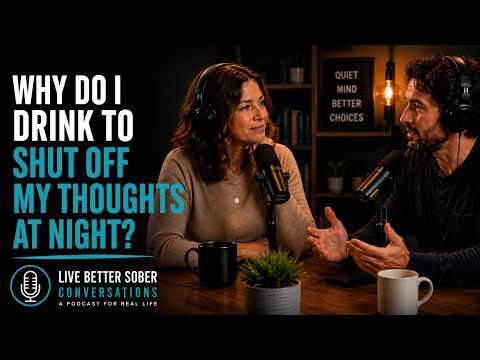
Want the Podcast Version of this Page?
Want to go deeper? The podcast version of this page explores these ideas in a more conversational and reflective way. You can listen to it below.
Ready for More Support?
Explore Live Better Sober: Quit Drinking — Break the Alcohol Habit, a practical, shame-free 66-day course designed to help you recognize and interrupt the pattern behind your evening drinking.
➡️ Learn more about the course here: Break the Nightly Drinking Habit
Frequently Asked Questions
Why does alcohol make my thoughts slow down?
Why does alcohol make my thoughts slow down?
Alcohol depresses parts of the nervous system, which can temporarily reduce awareness of stress, anxiety, and mental chatter. The effect is usually temporary.
Is drinking to shut off thoughts a sign of a bigger problem?
Is drinking to shut off thoughts a sign of a bigger problem?
Not necessarily, but it can indicate that alcohol has become a coping tool for stress, anxiety, or emotional discomfort. The more often it becomes the solution, the more important it is to examine the pattern.
Why do my thoughts seem worse after drinking?
Why do my thoughts seem worse after drinking?
Alcohol can disrupt sleep, increase anxiety during withdrawal, and reduce emotional resilience the next day. As a result, worries may feel more intense after the effects wear off.
What can I do instead of drinking when my mind won't stop racing?
What can I do instead of drinking when my mind won't stop racing?
Many people find relief through journaling, exercise, listening to a podcast, reading, deep breathing, talking with someone, or simply changing their environment for a short time.
Can overthinking trigger alcohol cravings?
Can overthinking trigger alcohol cravings?
Yes. For many nightly drinkers, mental overwhelm becomes one of the strongest triggers for wanting a drink because alcohol has been associated with temporary relief.
Why Nightly Drinking Sticks
Why Do I Drink Every Night? And Why It’s Hard to Stop
Why do I drink every night? Discover what’s really driving the habit and how to break it without willpower.
Why Is It Hard to Stop Drinking at Night?
Why is it hard to stop drinking at night? Learn why evening drinking feels so difficult and how to change it.
Wine O'Clock Habit Loop Explained
Wine O'Clock Habit Loop patterns often feel automatic. Learn why they happen and how to interrupt the evening drinking cycle.
Reward Drinking After a Hard Day: Why It Sticks
Reward drinking after a hard day can become an automatic nightly habit. Learn why it happens and what to do instead.



I'm Susan, creator of Live Better Sober, and in January 2028 I'll celebrate 30 years alcohol-free.
Everything on this site comes from my own experience.
I hope that by sharing what I've learned, I can help you break the nightly drinking habit, rediscover yourself, and live better sober, too.
I'm Susan, creator of Live Better Sober, and in January 2028 I'll celebrate 30 years alcohol-free.
Everything on this site comes from my own experience.
I hope that by sharing what I've learned, I can help you break the nightly drinking habit, rediscover yourself, and live better sober, too.
Stay Connected with Live Better Sober
Get new articles, personal stories, podcasts, and practical ideas to help make sober evenings easier.
No lectures. No labels. Just useful support from someone who's been there.


NEWSLETTER
HOME ABOUT CONTACT DISCLAIMER PRIVACY TERMS
FOLLOW US ON:



|
|
|
|
|
SEARCH THIS SITE
LIVE BETTER SOBER IS BASED ON SUSAN GAST'S PERSONAL EXPERIENCE WITH QUITTING ALCOHOL AND LONG-TERM SOBRIETY.
ALL CONTENT COPYRIGHT © 2026 LIVE BETTER SOBER BY SUSAN GAST • ALL RIGHTS RESERVED REGARDLESS OF LINKS OR ATTRIBUTIONS.
POWERED BY SBI! (SOLO BUILD IT!)
