- HOME
- Why Relapse Keeps Happening
- Drinking Again on Day Three
Why Do I Keep Drinking Again on Day Three?
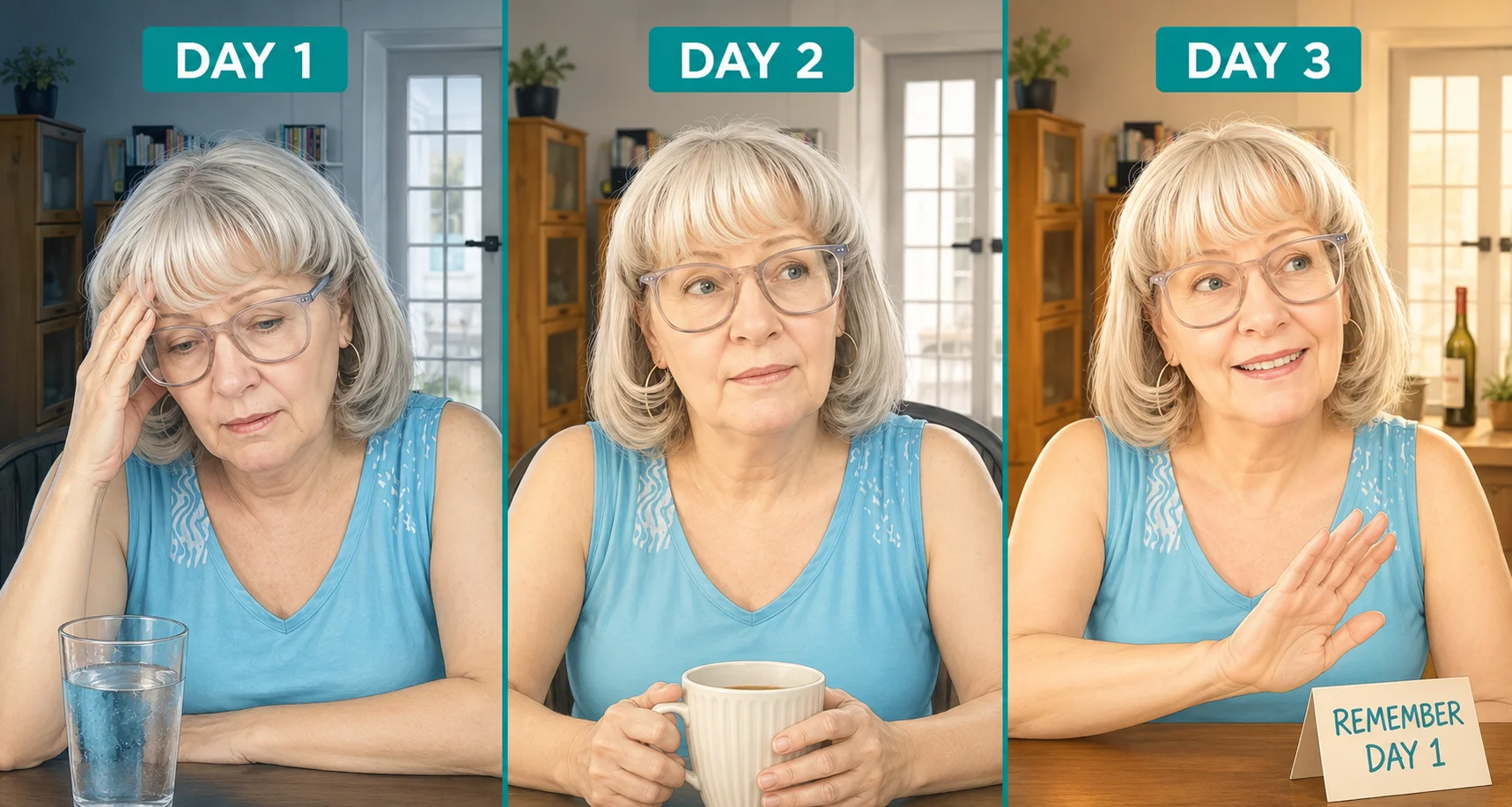
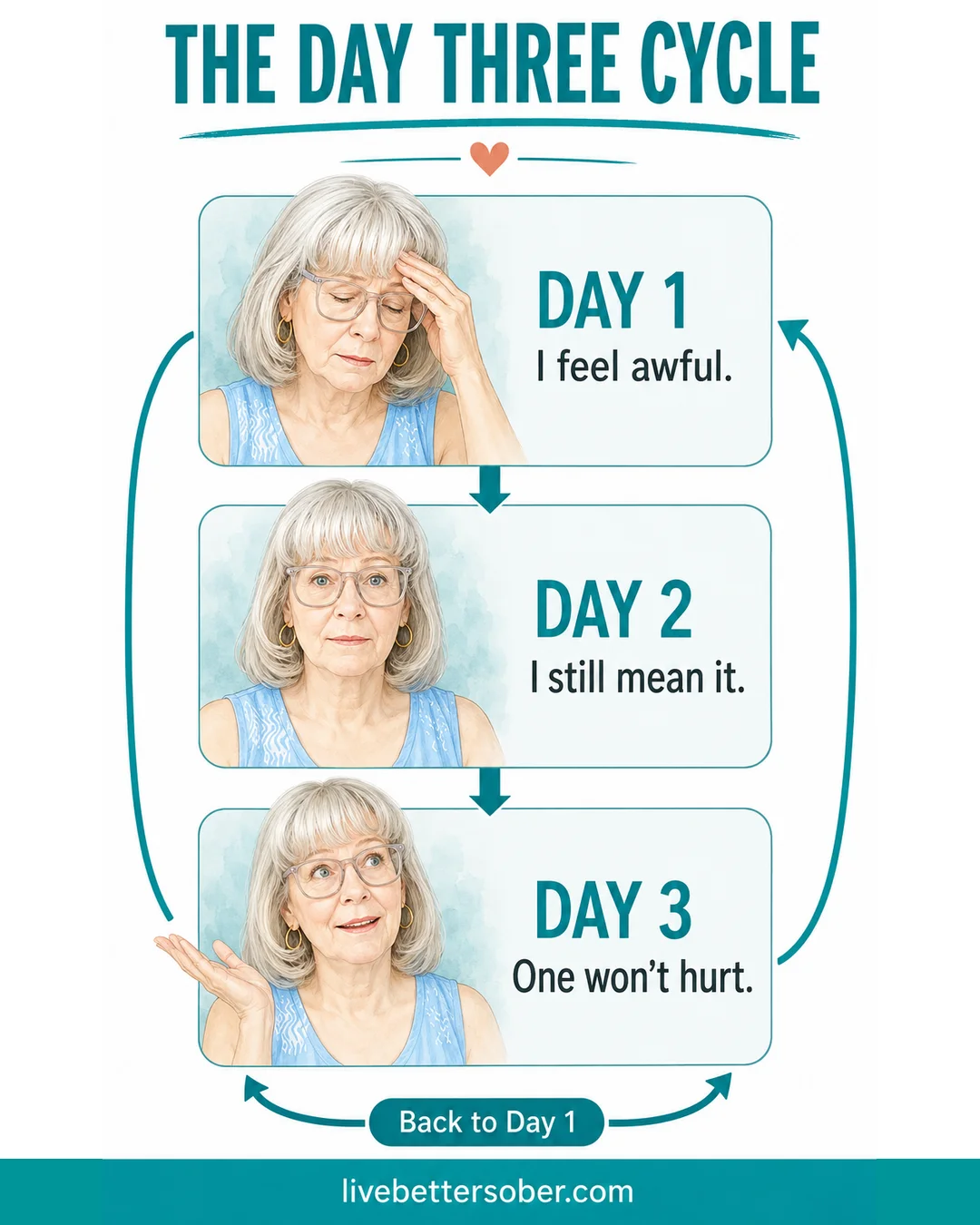
Have you noticed a relapsing on Day Three pattern? On Day One, you feel awful and promise yourself you will not drink again. On Day Two, the memory of what happened is still painfully clear.
But by Day Three, you feel a little better — and suddenly, having just one drink begins to sound perfectly reasonable.
If you keep drinking again on Day Three, it does not automatically mean you lack willpower or do not truly want to stop. It may mean that the evidence motivating you on Day One has lost some of its emotional force. You are feeling better, the worst consequences seem farther away, and your familiar nightly drinking habit is ready to resume exactly where it left off.
✅ Quick Answer: Why Do I Keep Drinking Again on Day Three?
You may drink again on Day Three because the hangover, regret, anxiety, or exhaustion that made you determined to stop no longer feels as immediate. As you begin feeling better, your mind may minimize what happened and suggest that this time you can have just one drink.
The problem is not necessarily that you have forgotten what happened. You may remember it factually without feeling it as strongly as you did on Day One.
Day Three can also fall within an important alcohol-withdrawal period for some people. If you have been drinking heavily or regularly for a prolonged period, obtain medical advice before suddenly stopping. Alcohol withdrawal can be dangerous and, in some cases, life-threatening.
The Day One to Day Three Drinking Cycle
A repeating three-day pattern can look something like this:
Day One: “I Never Want to Feel Like This Again”
The consequences of drinking are immediate.
You may wake up with a headache, nausea, anxiety, embarrassment, poor sleep, or incomplete memories of the previous night. Perhaps you said something you regret, argued with someone, or drank far more than you intended.
At that moment, stopping feels like the obvious decision.
You are not trying to remember why you want to stop. Your body and emotions are reminding you.
Day Two: “I Still Mean It”
By Day Two, you may still feel tired, shaky, unsettled, or disappointed in yourself.
You remember why you decided to stop, and you may still feel determined. Even if the worst of the hangover has passed, the experience remains close enough to influence your decision.
You might begin to feel cautiously hopeful. You have already made it through one evening without drinking.
Day Three: “Maybe I Can Have Just One”
By Day Three, something changes.
You may have slept better. Your anxiety may have eased. You feel more capable, more optimistic, and more like yourself.
Those improvements should be good news. Unfortunately, they can also weaken the emotional urgency behind your decision to stop.
Thoughts begin appearing:
- “Maybe my drinking wasn’t really that bad.”
- “I’ve had two nights off, so I’ve proved I can stop.”
- “I deserve a drink after doing so well.”
- “I’ll be more careful tonight.”
- “This time, I really will have only one.”
Nothing may have changed about what happens after your first drink. What changed was how strongly you could feel the reasons you wanted to avoid it.
My Own Day Three Pattern
In hindsight, I can see exactly why I kept drinking after repeatedly swearing off it.
Day One was the morning after the proverbial night before. I would wake up hungover and declare, “That’s it. I’m not drinking again.” And I meant it — at the time.
By Day Two, I was beginning to feel better, but the consequences were still fresh enough in my mind to keep me from drinking.
Then Day Three arrived.
By then, I felt “back to normal.” I had forgotten just how awful I had felt, and when the urge to drink returned, I convinced myself that one drink wouldn’t hurt.
But it did. That first drink restarted the same cycle: drink, regret it, swear it off, feel better — and drink again.
Until January 17, 1998.
That was the day I finally ended my Day Three cycle.
This was my personal experience. It does not mean everyone will have the same physical, emotional, or medical timeline.
Feeling Better Does Not Mean the Pattern Has Changed
Feeling better on Day Three is real — but it does not necessarily mean your relationship with alcohol has changed.
Before accepting the thought that tonight will be different, ask yourself:
What has actually changed since the last time I planned to have one drink?
Did you create a different plan? Remove the alcohol? Identify your trigger? Arrange support? Change what happens during your usual drinking hour?
Or do you simply feel better than you did on Day One?
That distinction matters.
Feeling better may change how you view the previous drinking episode. It does not guarantee that the next one will end differently.
What the “Just One Drink” Thought Leaves Out
The thought that you can have one drink may sound calm and logical. But it often focuses only on the first drink — not the complete sequence that usually follows it.
| The Day Three thought | What it may leave out |
|---|---|
| “I feel fine now.” | Feeling better is often when the urge to drink returns. |
| “I proved I can stop.” | Stopping briefly is different from changing the repeating pattern. |
| “I deserve a reward.” | Alcohol may be the very thing creating the cycle you want relief from. |
| “I’ll have only one.” | What usually happens after your first drink? |
| “This time will be different.” | What specific part of your plan is different? |
| “Maybe it wasn’t that bad.” | What did you know and feel on Day One? |
You do not have to argue with every thought about drinking. But you can learn to recognize when a familiar thought is presenting only part of the evidence.
Make the Day Three Decision on Day One
Day Three may not be the best time to decide whether drinking is a good idea.
By then, the immediate consequences have faded and the old drinking habit is beginning to make its case again.
Instead, use Day One to leave evidence for yourself.
Write down:
- What happened the previous night.
- How much you intended to drink and what actually happened.
- How you felt when you woke up.
- What you regretted.
- Why you wanted to stop.
- What “just one” usually became.
- What you do not want to repeat.
Do this while the experience is still clear — not to punish or shame yourself, but to preserve information you may minimize later.
Day One You is not being overly dramatic. She has access to evidence that Day Three You may struggle to feel.
Identify Your Vulnerable Day Three Window
The problem may not be the entire third day. It may be one predictable period during that day.
For many nightly drinkers, thoughts about alcohol become stronger:
- Near the end of the workday.
- While preparing dinner.
- When a partner pours a drink.
- When sitting in the usual drinking chair.
- After an upsetting conversation.
- When the house becomes quiet.
- During the time normally associated with pouring the first drink.
Ask yourself:
What time does my thinking usually begin to change?
Then prepare for that specific window.
You do not need to plan every minute of the day. You need a plan for the time when your nightly drinking habit normally expects to begin.
Create a Day Three Protection Plan
Complete this plan before Day Three arrives:
My usual vulnerable time:
The situation that usually triggers the thought:
The thought I expect to hear:
What that thought leaves out:
What I will read to remind myself of Day One:
The person I can contact:
Where I can go or what I can do instead:
What I will do with any alcohol in the house:
Your plan does not have to remove every thought or craving. Its purpose is to prevent one familiar thought from automatically becoming one familiar action.
Notice the Somatic Marker Moment
A Somatic Marker Moment is a moment when an experience creates a strong emotional and physical signal — something you feel in your body as well as understand in your mind.
Your Day One experience may contain several of these moments:
- Waking with dread before opening your eyes.
- Discovering an empty bottle.
- Reading a message you do not remember sending.
- Seeing disappointment on someone’s face.
- Feeling your heart race with morning anxiety.
- Promising yourself, once again, that tonight will be different.
These moments contain valuable information.
The goal is not to live forever inside the pain of Day One. It is to capture what that experience taught you so you can still use the information when the pain has faded.
A somatic marker memory I used a lot was recalling how ill I felt on January 17th. That was enough to deter me from filling a glass with whiskey and Diet Coke.
What If I Already Drank Again?
Drinking again does not mean you should abandon the rest of the evening, the following morning, or your larger goal.
Instead of telling yourself, “I’ve ruined everything,” ask:
- What happened before I decided to drink?
- What was I thinking?
- What was I feeling in my body?
- What time did the decision change?
- What cue was present?
- What did I expect the drink to do for me?
- What protection was missing from my plan?
A return to drinking can provide useful information about the point where your current plan needs more support.
You do not have to turn one drink or one evening into permission to continue the cycle.
Could This Be Alcohol Withdrawal?
Not every difficult Day Three is simply a habit or a change of mind.
Alcohol-withdrawal symptoms can begin within hours after the last drink and may peak within 24 to 72 hours. Symptoms can include shakiness, sweating, nausea, anxiety, disturbed sleep, rapid heart rate, confusion, hallucinations, or seizures. Experiences vary considerably from person to person.
If you have been drinking heavily or regularly for a prolonged period, have experienced withdrawal before, or are concerned about your symptoms, speak with a healthcare professional before attempting to stop suddenly.
Alcohol withdrawal can become life-threatening. Call 911 or seek emergency medical care for symptoms such as:
- A seizure.
- Hallucinations.
- Severe confusion.
- Loss of consciousness.
- Chest pain.
- Difficulty breathing.
- Severe agitation or rapidly worsening symptoms.
For authoritative information, see:
- NIAAA: Treatment for Alcohol Problems
- MedlinePlus: Alcohol Withdrawal
- NIAAA Alcohol Treatment Navigator
The strategies on this page are intended to help you recognize a behavioral drinking pattern. They are not a substitute for medical evaluation or treatment for alcohol withdrawal.
What should I do before my next Day Three?
Record what you experienced on Day One, identify when your thinking normally changes, prepare for your usual drinking hour, and decide how you will answer the “just one” thought before it arrives.
You may also want to involve someone you trust or seek professional support rather than trying to manage a repeated pattern alone.
You Do Not Have to Keep Returning to Day One
If you repeatedly drink again on Day Three, the pattern is not proof that you are incapable of changing.
It is a pattern — and patterns can be examined.
You can identify what changes between Day One and Day Three. You can preserve the evidence you normally minimize. You can prepare for the thought that usually catches you off guard.
Most importantly, you can stop treating every return to drinking as a personal failure and begin treating it as information.
Use my free Somatic Marker Moments Workbook to capture the moments your mind may later try to soften, dismiss, or forget.
If you repeatedly drink again on Day Three, the pattern is not proof that you are incapable of changing.
It is a pattern — and patterns can be examined.
You can identify what changes between Day One and Day Three. You can preserve the evidence you normally minimize. You can prepare for the thought that usually catches you off guard.
Most importantly, you can stop treating every return to drinking as a personal failure and begin treating it as information.
Use my free Somatic Marker Moments Workbook to capture the moments your mind may later try to soften, dismiss, or forget.
If your nightly drinking habit continues to restart despite your efforts, my 66-day Break the Nightly Drinking Habit course offers a practical, shame-free structure for understanding and changing the pattern.
Continue Exploring Why Relapse Keeps Happening
If you've stopped drinking before but found yourself slipping back into old habits, you're not alone. These articles explore why relapse happens, what you can learn from it, and how to move forward with greater confidence and self-understanding.
→ Browse all Why Relapse Keeps Happening articles
Ready for More Support?
Explore Live Better Sober: Quit Drinking — Break the Alcohol Habit, a practical, shame-free 66-day course designed to help you recognize and interrupt the pattern behind your evening drinking.
➡️ Learn more about the course here: Break the Nightly Drinking Habit
Frequently Asked Questions
Why do I keep drinking again after three days?
Why do I keep drinking again after three days?
You may feel strongly motivated to stop while the consequences of drinking are immediate. After two or three days, you begin feeling better, the consequences feel more distant, and the thought that you can have one drink becomes more persuasive.
Physical withdrawal, cravings, habitual cues, stress, and your normal drinking environment may also play a role. There is no single explanation that applies to everyone.
Is Day Three always the hardest day without alcohol?
Is Day Three always the hardest day without alcohol?
No. Some people find Day Three particularly difficult, while others struggle earlier or later.
For some people, withdrawal symptoms may peak during the first 24 to 72 hours. Others begin feeling physically better by Day Three but struggle with cravings, habitual drinking cues, or the belief that they can now control their drinking.
Does feeling better mean alcohol withdrawal is over?
Does feeling better mean alcohol withdrawal is over?
Not necessarily. Withdrawal does not follow one identical timeline for everyone.
If you have been drinking heavily or regularly, do not use how you feel at one particular moment as proof that medical risk has passed. Ask a healthcare professional for individualized advice.
Why do I suddenly believe I can have one drink?
Why do I suddenly believe I can have one drink?
As the negative consequences fade, your mind may focus more strongly on the expected reward or relief associated with drinking.
The thought of one drink can also leave out what normally happens after that drink. Looking at the complete pattern — not only the first few minutes — can help you make a more informed decision.
Is drinking after three days considered a relapse?
Is drinking after three days considered a relapse?
People use the words lapse, slip, relapse, and return to drinking differently. The label matters less than understanding what happened and deciding what support or change you need next.
One drinking episode does not erase the alcohol-free days or the information you gained from them.
Why Relapse keeps Happening
Why Do I Keep Going Back to Drinking Again?
Why do I keep going back to drinking? Understand why this pattern repeats and what’s really going on.
Why Do I Relapse at the Same Time Again?
Why do I relapse at the same time? Learn why patterns like Day 7 or Day 10 keep repeating.



I'm Susan, creator of Live Better Sober, and in January 2028 I'll celebrate 30 years alcohol-free.
Everything on this site comes from my own experience.
I hope that by sharing what I've learned, I can help you break the nightly drinking habit, rediscover yourself, and live better sober, too.
I'm Susan, creator of Live Better Sober, and in January 2028 I'll celebrate 30 years alcohol-free.
Everything on this site comes from my own experience.
I hope that by sharing what I've learned, I can help you break the nightly drinking habit, rediscover yourself, and live better sober, too.


Stay Connected with Live Better Sober
Get new articles, personal stories, podcasts, and practical ideas to help make sober evenings easier.
No lectures. No labels. Just useful support from someone who's been there.


NEWSLETTER
HOME ABOUT CONTACT DISCLAIMER PRIVACY TERMS
FOLLOW US ON:



|
|
|
|
|
SEARCH THIS SITE
LIVE BETTER SOBER IS BASED ON SUSAN GAST'S PERSONAL EXPERIENCE WITH QUITTING ALCOHOL
AND LONG-TERM SOBRIETY.
ALL CONTENT COPYRIGHT © 2026 LIVE BETTER SOBER BY SUSAN GAST • ALL RIGHTS RESERVED REGARDLESS OF LINKS OR ATTRIBUTIONS.
POWERED BY SBI! (SOLO BUILD IT!)
