- HOME
- The Live Better Sober Approach
- Somatic Marker Method
- Identify Your Drinking Triggers
How to Identify Your Drinking Triggers

Written by Susan — Quit drinking at 37 • Sober since 1998 • Sharing what actually works
Written by Susan — Quit drinking at 37 • Sober since 1998 • Sharing what actually works
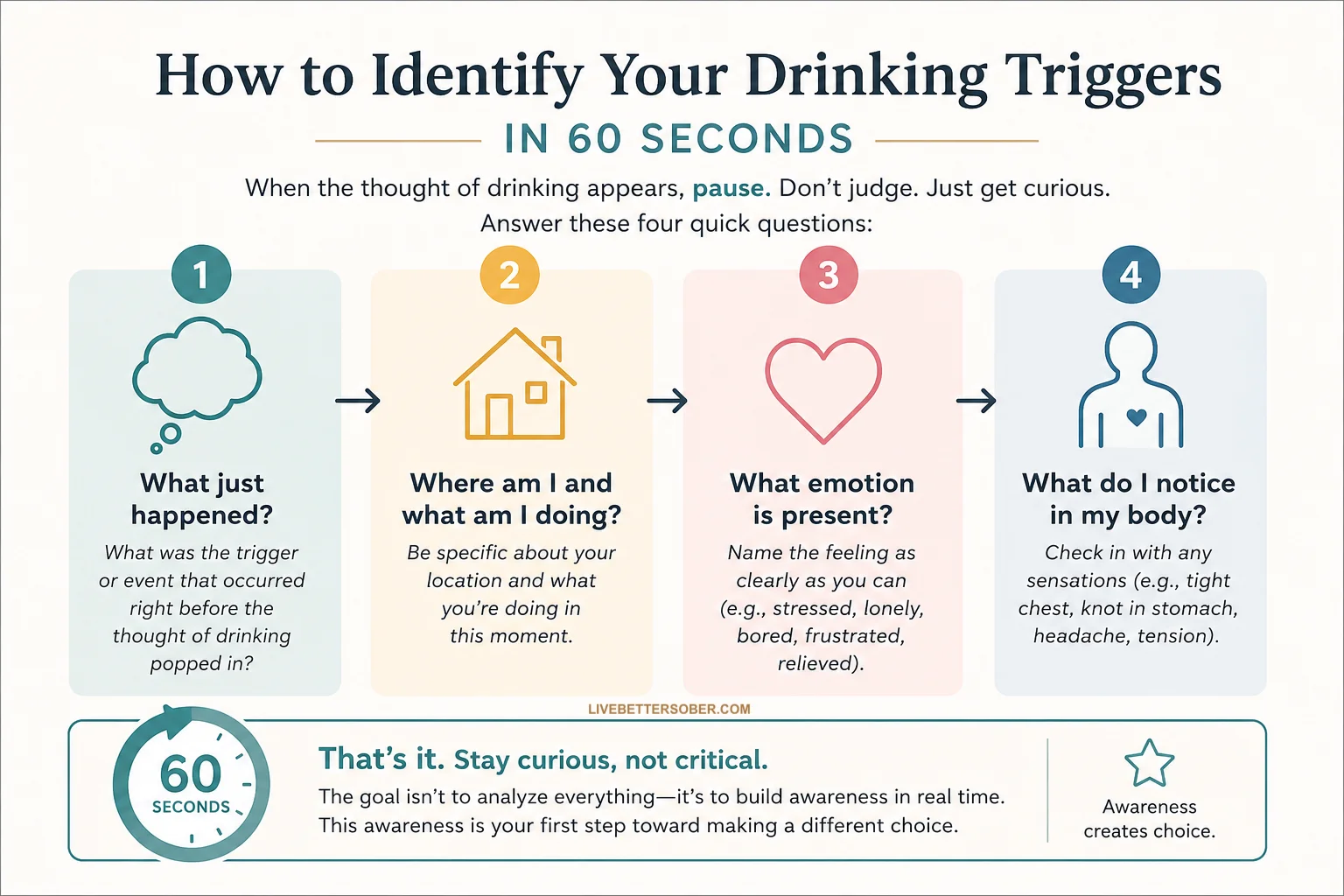
How to identify your drinking triggers? Pause the moment alcohol pops into your mind. Instead of picking apart your entire day, ask yourself what just happened, what you were feeling, and what changed inside your body.
Those clues can show you exactly what set the urge in motion.
✅ Quick Answer: How do I identify my drinking triggers?
Pause as soon as the thought of drinking appears and ask what happened immediately before it. Notice where you are, what you are doing, what emotion is present, and what you feel inside your body. The situation or feeling may be the trigger, while the remembered physical and emotional outcome is the somatic marker that can help you recognize the pattern sooner next time.
Why Evening Drinking Triggers Can Be Hard to See
The thought of drinking can simply pop into your mind. One minute you’re getting on with your evening, and the next you’re thinking about pouring a drink. Most of the time, you have no conscious idea what prompted the thought. It just arrives.
The same thing happens when you suddenly remember the slice of Key lime pie in the refrigerator. You didn’t deliberately decide to think about pie. But now that the thought has appeared, the wanting begins — and before long, you may find yourself standing in front of the refrigerator.
Evening drinking can work in much the same way. It’s 5 o’clock, you’re home, and alcohol pops into your mind because that’s what normally happens next. Your brain has connected this time, place, or moment with drinking so many times that it no longer needs your conscious involvement.
You have to catch the thought and ask, “Why did alcohol pop into my mind just now?”
If you don’t catch it immediately, that doesn’t mean you lack willpower. Willpower hasn’t even entered the picture yet. That comes later, when you start debating whether to drink. At this stage, you’re simply building awareness of a thought process that has been running automatically for a long time.
What Counts as a Drinking Trigger?
A drinking trigger can come from something happening around you or something happening inside you. Quite often, it’s a mixture of both.
External triggers come from your surroundings or your usual routine. You finish work, arrive home, change into something comfortable, and settle into your favorite chair. Perhaps you start preparing dinner, see the wineglass you normally use, or hear your partner open a drink. Your brain recognizes the familiar setup and expects alcohol to come next.
Internal triggers come from your thoughts, feelings, and physical state. You may feel stressed after a difficult day, bored with the evening ahead, lonely, resentful, exhausted, or desperate to switch off. Something good may have happened and you want to celebrate. Something bad may have happened and you want to forget it.
These triggers can easily pile on top of one another. You arrive home at the usual time, sit in the usual place, and bring the stress of the day with you. Now you have the familiar routine and the uncomfortable feeling both pointing toward the same familiar answer: have a drink.
You don’t need to find one perfect explanation for the urge. The time, place, routine, thought, feeling, or any combination of them can count as your drinking trigger.
How to Identify Your Drinking Triggers in 60 Seconds
The Trigger and the Somatic Marker Do Different Jobs
A trigger sets the thought of drinking in motion. It might be 5 o’clock, arriving home after work, walking into the kitchen, feeling stressed, or thinking, “Sod it, I’ve had a bad day. I’m having a drink.”
Your somatic marker is the remembered physical and emotional outcome of following that urge — the drinks that turned into too many, the broken sleep, the pounding headache, the sick feeling, and the regret the following morning.
Imagine you arrive home after a dreadful day, and the thought of alcohol pops into your mind. The bad day and your familiar evening routine are the triggers. They point you toward the relief you expect from that first drink.
Your somatic marker points you toward the rest of the story.
It reminds you that the anticipated relief didn’t last. Perhaps one drink became three or four, you slept badly, and you woke with a headache feeling annoyed with yourself. Recalling how that experience genuinely felt gives your brain information that the promise of immediate relief conveniently leaves out.
The trigger says, “A drink will make this evening better.”
Your somatic marker answers, “But remember how this really ended last time.”
Give Your Somatic Marker a Name You’ll Recognize
You don’t need a clinical or clever name for your somatic marker. You need a few words that immediately bring back the drinking experience and how it ended.
My three strongest somatic markers have very straightforward names: January 17, 1998; Cold Puke on the Carpet; and the Semi-Truck Trailer Incident.
Each name means something very specific to me. I don’t need to reconstruct the entire night or write a detailed account every time the thought of drinking appears. The name brings back enough of the physical and emotional reality to remind me where drinking can lead.
Your marker might be “The Morning I Missed Work,” “The Argument in the Kitchen,” “The Three-A.M. Shame,” or simply a date that you will never forget. Nobody else has to understand the name. It only needs to bring the truth of that experience back to you quickly.
When alcohol promises relief, your named somatic marker gives you an immediate answer based on what actually happened — not what you hope will happen this time.
Recognizing Your Triggers Gets Easier With Practice
You may not catch the sequence perfectly the first time. The thought of drinking can appear so quickly that you only notice it once the urge has already taken hold. That’s okay. Every time you pause and look back at what just happened, you strengthen your awareness and make the sequence easier to spot next time.
You’re not trying to analyze yourself perfectly or uncover one deep explanation for why you drink. You’re learning to notice your own familiar triggers before they take you by surprise.
Practical Action Step: Catch Tonight’s Trigger
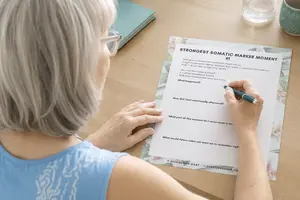
When alcohol pops into your mind tonight, pause for 60 seconds. Write down what happened immediately beforehand, where you were, what you were doing, what emotion you felt, and what you noticed in your body.
Give that drinking experience a short name you’ll recognize immediately and record it as one of your somatic markers in the free My Somatic Marker Moments Workbook.
The trigger helps you understand why alcohol popped into your mind. Your somatic marker reminds you how following that thought has ended before. Together, they give you a better chance to make a different choice tonight.
Continue Exploring The Live Better Sober Approach
Every woman finds her own path, but understanding why your nightly drinking habit developed can make that path much easier. Explore the ideas behind the Live Better Sober approach, including habit loops, Somatic Marker Moments, and building lasting change without shame.
→ Browse all Live Better Sober Approach articles
Ready for More Support?
Explore Break the Nightly Drinking Habit, a practical, shame-free 66-day course designed to help you recognize and interrupt the pattern behind your evening drinking.
➡️ Learn more about the course here: Break the Nightly Drinking Habit
Frequently Asked Questions
What are the most common evening drinking triggers?
What are the most common evening drinking triggers?
Common triggers include finishing work, preparing dinner, feeling stressed or bored, being alone, spending time with someone who drinks, and reaching the point when you usually pour your first drink. Your trigger may also be a thought such as “I deserve this” or “I need something to help me switch off.”
Can a certain time of day be a drinking trigger?
Can a certain time of day be a drinking trigger?
Yes. If you regularly drink at approximately the same time, your brain can begin anticipating alcohol as that time approaches. The clock, changing light, the end of work, or the beginning of dinner may all become part of the learned pattern.
What is the difference between a drinking trigger and a craving?
What is the difference between a drinking trigger and a craving?
A trigger sets the thought of drinking in motion. A craving is the resulting desire or urge to drink. The two can happen so close together that they feel like one experience, which is why pausing to consider what happened immediately beforehand can help.
What if I cannot identify what triggered me?
What if I cannot identify what triggered me?
Start with what you can observe rather than forcing yourself to find a deep emotional explanation. Note the time, place, activity, thought, emotion, and body sensation. Repeated observations over several evenings may reveal a pattern that was not obvious from one occasion.
The Liver Better Sober Approach
Alternatives to AA — What if Meetings Aren’t for You?
Looking for alternatives to AA? Discover supportive, non-traditional approaches to quitting drinking that don’t rely on meetings or labels.
How to Stop Drinking Without AA
How to stop drinking without AA using practical routines, realistic habit change, and simple nightly strategies that actually stick
Shame-Free Sobriety Approach That Actually Helps
Shame-free sobriety approach means learning from your drinking years without carrying lifelong self-condemnation.
Somatic Marker Method Overview
Somatic Marker Method overview for women using meaningful drinking memories to guide calmer, shame-free choices about alcohol.
How to Recover After a Slip Without Spiraling
Learn how to recover after a drinking slip without shame, use last night as honest information, and choose one helpful next step.



I’m Susan, creator of Live Better Sober, and in January 2028 I’ll celebrate 30 years alcohol-free.
I created this site to share a calmer, more practical approach for people who want to break the nightly drinking habit and build a better life without alcohol.
I’m Susan, creator of Live Better Sober, and in January 2028 I’ll celebrate 30 years alcohol-free.
I created this site to share a calmer, more practical approach for people who want to break the nightly drinking habit and build a better life without alcohol.
Stay Connected with Live Better Sober
Get new articles, personal stories, podcasts, and practical ideas to help make sober evenings easier.
No lectures. No labels. Just useful support from someone who's been there.


NEWSLETTER
HOME ABOUT CONTACT DISCLAIMER PRIVACY TERMS
FOLLOW US ON:



|
|
|
|
|
SEARCH THIS SITE
LIVE BETTER SOBER IS BASED ON SUSAN GAST'S PERSONAL EXPERIENCE WITH QUITTING ALCOHOL AND LONG-TERM SOBRIETY.
ALL CONTENT COPYRIGHT © 2026 LIVE BETTER SOBER BY SUSAN GAST • ALL RIGHTS RESERVED REGARDLESS OF LINKS OR ATTRIBUTIONS.
POWERED BY SBI! (SOLO BUILD IT!)
