- HOME
- The Live Better Sober Approach
- AA Alternatives
Alternatives to AA — What if Meetings Aren’t for You?

Written by Susan — Quit drinking at 37 • Sober since 1998 • Sharing what actually works
Written by Susan — Quit drinking at 37 • Sober since 1998 • Sharing what actually works
If you’ve searched for alternatives to AA, there’s a good chance you already know you want to change your drinking habits — but you’re not sure traditional recovery meetings are the right fit for you.
And honestly, that’s more common than people think. Not everyone connects with group meetings, labels, or standing up in front of strangers to talk about personal struggles.
That doesn’t mean you’re doomed to keep drinking forever. It simply means you may need a different way forward.
✅ Quick Answer: What are the best alternatives to AA?
The best alternatives to AA are structured methods that help you change your drinking habits in a realistic and repeatable way. For many people, that includes daily routines, accountability, education, habit tracking, online support, or guided programs that focus on practical change instead of labels or meetings.
🎙️ Want to hear the podcast hosts’ take?
The podcast conversation explores this topic from another perspective.
Jump to the podcast episode.
Maybe the Problem Isn’t You
A lot of people assume that if AA doesn’t feel right, then they must not be trying hard enough. But recovery is not one-size-fits-all.
Some people thrive in group environments. Others don’t.
They may want:
- meetings
- sponsors
- lifelong recovery identities
Others simply want:
- to stop drinking nightly
- to regain control
- to feel healthier
- to sleep better
- to stop thinking about alcohol constantly
Those are two very different mindsets.
And it’s important to understand that not connecting with AA does not automatically mean you “don’t want help.”
Many Nightly Drinkers Don’t Relate to Traditional Recovery
One reason people search for alternatives to AA is because they don’t fully relate to the stories they hear in traditional recovery settings.
They may still:
- work every day
- take care of their families
- pay bills
- function normally on the outside
But privately?
Drinking has become a nightly pattern they can’t seem to break.
That gray-area experience can feel confusing because you know something isn’t right — but you also don’t identify with the stereotype of severe alcoholism.
And because of that, many people delay making changes for years.
It’s Okay If AA Doesn’t Feel Like You
When I was in my late 20s, I worked for a local newspaper. I was surprised to learn that one of the guys there attended AA meetings because I never would have guessed he had a drinking problem. It reminded me that you often can’t tell what someone is struggling with from the outside.
At one point, I casually mentioned that I’d be interested in going to a meeting myself. To his credit, he was completely non-judgmental. But when I finally showed up, I felt deeply uncomfortable. I didn’t want to stand up and say, “Hi, I’m Susan, and I’m an alcoholic.” I’ve always been shy by nature, so having a room full of people focus their attention on me honestly felt overwhelming.
The Real Problem Is Often the Habit Loop
For many people, the issue is not simply alcohol itself.
It’s the repeated nightly loop:
trigger → drink → temporary relief → repeat.
And once that loop becomes automatic, quitting can feel surprisingly difficult even when you genuinely want to stop.
Structure Often Works Better Than Willpower
One of the biggest mistakes people make is relying entirely on motivation.
They say:
- “I’ll just stop.”
- “I’ll try harder.”
- “This time I mean it.”
But habits usually don’t disappear because of motivation alone.
That’s why practical systems often work better.
Structure creates:
- awareness
- consistency
- accountability
- momentum
- small daily wins
And for many people stuck in drinking routines, that practical method feels far more realistic than trying to completely reinvent their identity overnight.
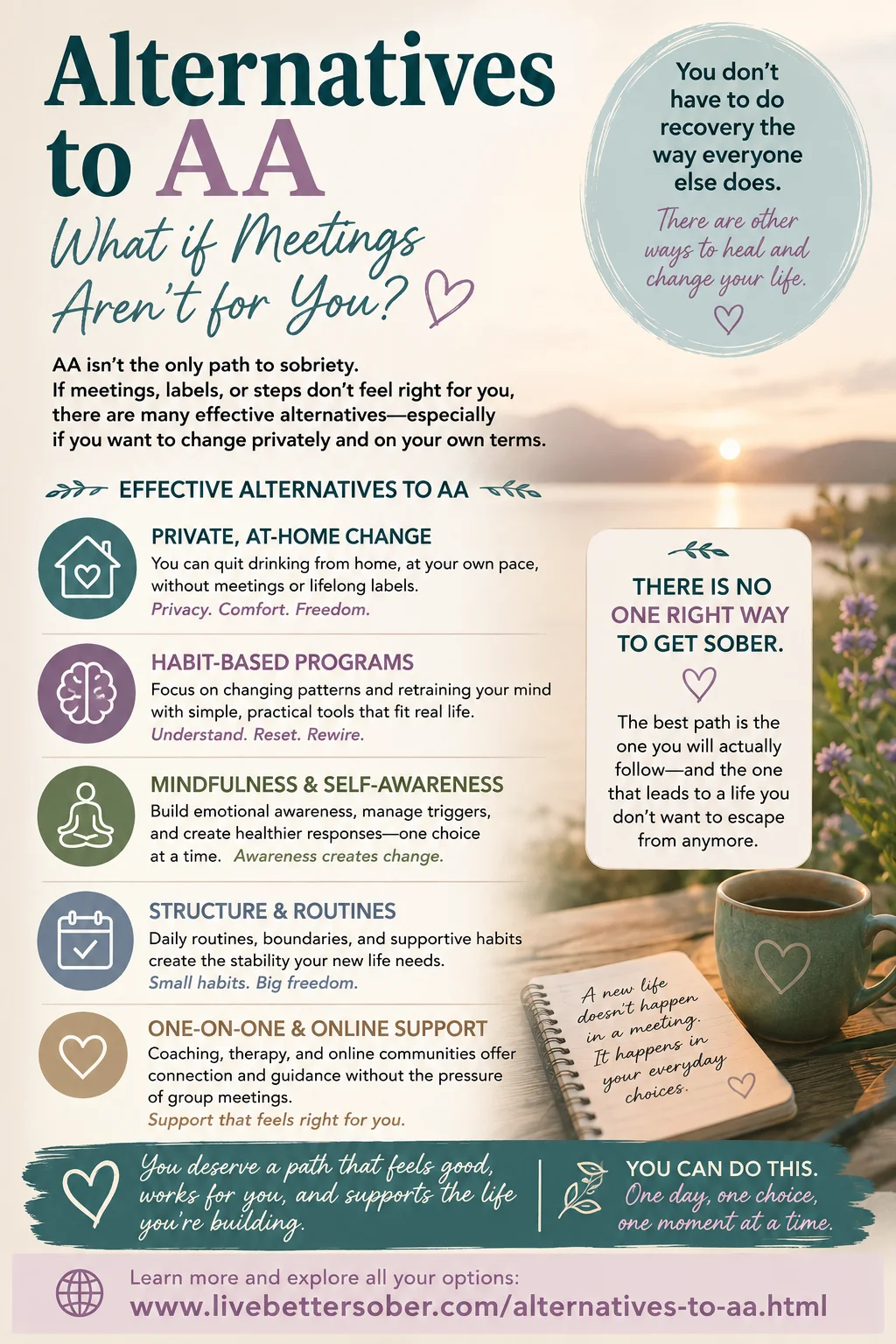
Recovery Alternatives Comparison
Not every recovery path works for every personality, lifestyle, or drinking pattern.
Some people thrive in group meetings and shared experiences, while others prefer private, practical, or habit-based systems that focus more on daily routines and behavior change.
The good news is that there are now many alternatives to AA, and different types of support work for different people.
The goal isn’t to force yourself into a recovery style that feels wrong — it’s to find support you can realistically live with day after day.
Others prefer practical programs like SMART Recovery, which focuses on coping skills, behavior patterns, and self-management tools rather than labels or sponsorships.
Many are drawn to mindfulness-based communities like Recovery Dharma, which uses meditation and self-awareness practices to help people better understand their relationship with alcohol.
Programs like Women for Sobriety are designed specifically for women and focus heavily on self-esteem, emotional growth, and building healthier thinking patterns in everyday life.
For people who feel uncomfortable sharing in groups, therapy or recovery coaching can offer more private one-on-one support while still providing accountability and structure.
And for many people caught in habitual drinking patterns, habit-based systems can feel especially helpful because they focus less on identity and more on changing the routines, triggers, and patterns that keep alcohol stuck in daily life.
You Don’t Have To Label Yourself Forever
Another reason some people avoid AA is because they don’t want alcohol to become their lifelong identity.
They don’t want every introduction to begin with:
“Hi, I’m Susan, and I’m an alcoholic.”
Instead, they simply want:
- peace
- control
- freedom
- better evenings
- healthier routines
That desire is valid.
And while some people genuinely benefit from recovery communities and labels, others respond better to a habit-change path focused on building a different daily life.
Research continues to show that recovery is not one-size-fits-all. Studies have found that people can successfully change their drinking habits through a variety of methods, including therapy, peer support, mindfulness practices, and habit-based paths.
What feels supportive and sustainable for one person may feel completely wrong for someone else — which is why finding a path that genuinely fits your personality and daily life matters so much.
There Are Different Ways Forward
The important thing is not whether your path looks like someone else’s.
It’s:
- finding a system that fits you
- building supportive routines
- staying consistent
- learning why the pattern keeps repeating
Because when you understand the pattern, you can finally start changing it.
And that’s often when people begin to realize why quitting entirely on their own feels so difficult.
If you’ve ever wondered why quitting feels easy for a few days — and then suddenly much harder — the next page explains what’s really happening behind the scenes.
Continue Exploring The Live Better Sober Approach
Every woman finds her own path, but understanding why your nightly drinking habit developed can make that path much easier. Explore the ideas behind the Live Better Sober approach, including habit loops, Somatic Marker Moments, and building lasting change without shame.
→ Browse all Live Better Sober Approach articles
Ready for More Support?
Explore Live Better Sober: Quit Drinking — Break the Alcohol Habit, a practical, shame-free 66-day course designed to help you recognize and interrupt the pattern behind your evening drinking.
➡️ Learn more about the course here: Break the Nightly Drinking Habit
Frequently Asked Questions About Alternatives to AA
Do I have to go to AA to stop drinking?
Do I have to go to AA to stop drinking?
No. Many people stop drinking through structured habit changes, therapy, online programs, support groups, routines, or personal accountability systems.
What if I don’t relate to recovery meetings?
What if I don’t relate to recovery meetings?
That’s more common than many people realize. Many connect strongly with meetings, while others prefer quieter, more private, or more guided support.
Can you quit drinking without calling yourself an alcoholic?
Can you quit drinking without calling yourself an alcoholic?
Yes. Many people focus on changing their drinking habits without adopting a lifelong label or recovery identity.
Want the Podcast Version of this Page?
Want to go deeper? The podcast version of this page explores these ideas in a more conversational and reflective way. You can listen to it below.
The Live Better Sober Approach
How to Stop Drinking Without AA
How to stop drinking without AA using practical routines, realistic habit change, and simple nightly strategies that actually stick
Shame-Free Sobriety Approach That Actually Helps
Shame-free sobriety approach means learning from your drinking years without carrying lifelong self-condemnation.
Somatic Marker Method Overview
Somatic Marker Method overview for women using meaningful drinking memories to guide calmer, shame-free choices about alcohol.
How to Recover After a Slip Without Spiraling
Learn how to recover after a drinking slip without shame, use last night as honest information, and choose one helpful next step.
How to Identify Your Drinking Triggers
How to identify your drinking triggers by noticing the situations, feelings, and body signals connected to your evening urge to drink.




I'm Susan, creator of Live Better Sober, and in January 2028 I'll celebrate 30 years alcohol-free.
Everything on this site comes from my own experience.
I hope that by sharing what I've learned, I can help you break the nightly drinking habit, rediscover yourself, and live better sober, too.
I'm Susan, creator of Live Better Sober, and in January 2028 I'll celebrate 30 years alcohol-free.
Everything on this site comes from my own experience.
I hope that by sharing what I've learned, I can help you break the nightly drinking habit, rediscover yourself, and live better sober, too.
Stay Connected with Live Better Sober
Get new articles, personal stories, podcasts, and practical ideas to help make sober evenings easier.
No lectures. No labels. Just useful support from someone who's been there.


NEWSLETTER
HOME ABOUT CONTACT DISCLAIMER PRIVACY TERMS
FOLLOW US ON:



|
|
|
|
|
SEARCH THIS SITE
LIVE BETTER SOBER IS BASED ON SUSAN GAST'S PERSONAL EXPERIENCE WITH QUITTING ALCOHOL AND LONG-TERM SOBRIETY.
ALL CONTENT COPYRIGHT © 2026 LIVE BETTER SOBER BY SUSAN GAST • ALL RIGHTS RESERVED REGARDLESS OF LINKS OR ATTRIBUTIONS.
POWERED BY SBI! (SOLO BUILD IT!)
