- HOME
- Shame-Free First Steps
- Sober Curious First Steps
Sober Curious First Steps: Where to Begin

Written by Susan — Quit drinking at 37 • Sober since 1998 • Sharing what actually works
Written by Susan — Quit drinking at 37 • Sober since 1998 • Sharing what actually works
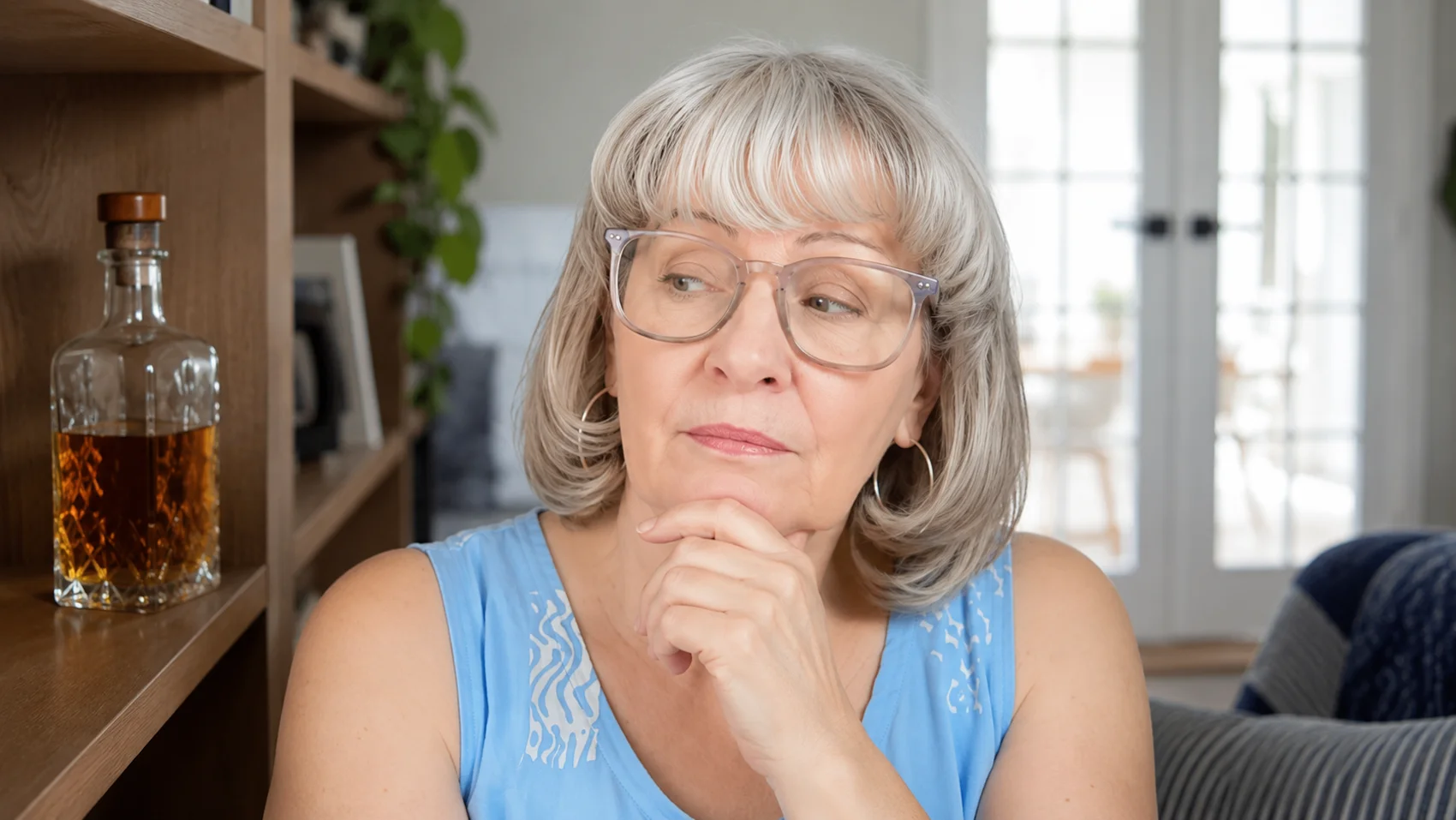
Sober curious first steps don't begin with promising never to drink again. They begin with curiosity. If you've started wondering why alcohol has become such an automatic part of your evenings, you're already asking an important question.
You don't have to label yourself or make a lifelong commitment today. You simply need permission to pause, observe what's happening, and see where that curiosity leads.
✅ Quick Answer: Where do I start if I'm sober curious?
Start with curiosity instead of commitment. You don't have to decide your entire future today. Simply notice your drinking habits, try one alcohol-free evening, and pay attention to what your thoughts and routines reveal.
What Does "Sober Curious" Really Mean?
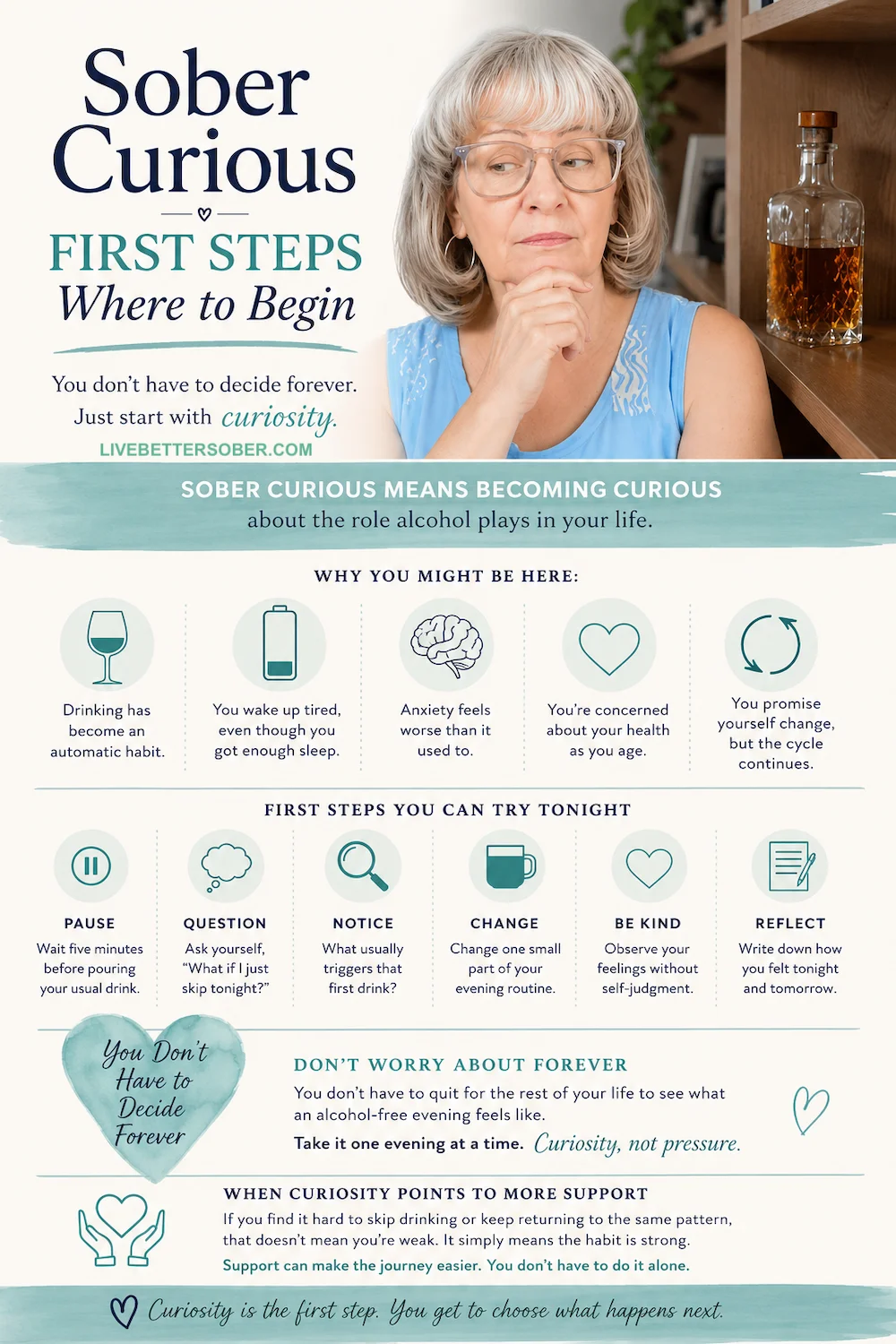
Being sober curious simply means becoming curious about the role alcohol plays in your life.
Instead of automatically pouring the usual evening drink, you begin asking questions:
- Why do I drink every night?
- How would I feel if I didn't?
- Is alcohol actually helping me anymore?
- What might change if I took a break?
The important thing is that sober curiosity isn't about giving yourself a lifelong label or announcing you'll never drink again.
It's about giving yourself permission to experiment.
Maybe you skip drinking for a few evenings. Maybe you try a month without alcohol. Maybe you simply start noticing when, why, and how often you reach for that first glass.
Curiosity replaces pressure.
Instead of asking, "Can I quit forever?" you begin asking, "What happens if I don't drink tonight?"
That small shift feels much less overwhelming — and for many women, it's the first step toward discovering they enjoy life more without alcohol than they ever expected.
I never called myself "sober curious" back in 1998 because the phrase didn't exist then. But looking back, I had reached the point where I couldn't ignore the questions anymore.
Drinking had become so automatic that I wasn't really choosing it — it was simply what I did every evening. I'd get home, get comfy, and a glass of whiskey and Coke was in my hand before I'd even realized I'd poured it.
Why You Might Be Feeling Sober Curious
Most women don't wake up one morning and suddenly decide to question their drinking.
It's usually something much more subtle.
Perhaps you've noticed that your evening glass of wine has become two. Or maybe you realize you haven't missed a night in months — or even years. The habit feels less like a choice and more like part of your evening routine, right alongside making dinner or watching television.
You might also be wondering why you're waking up tired despite getting enough sleep. Perhaps your anxiety feels worse than it used to, or you're becoming more concerned about what alcohol is doing to your health as you get older.
Sometimes it's the emotional side that gets your attention.
I remember promising myself in the morning that tonight will be different, only to find myself pouring another drink by evening. Afterwards, I'd feel so disappointed, frustrated, or ashamed — not because I wanted to get drunk, but because I didn't seem able to keep the promise not to drink that I'd made to myself.
Over time, I noticed that alcohol no longer gave me what it once did. Instead of helping me relax, it left me feeling sluggish the next day, less motivated, and wishing I had more energy for the things that really matter in life.
Back then, I didn't bother asking myself whether I actually wanted a drink. I just drank.
Sober Curious First Steps You Can Try Tonight
You don't have to overhaul your life overnight.
In fact, one of the biggest mistakes people make is believing they have to commit to "never drinking again" before they even know if they're ready.
Instead, think of tonight as an experiment.
Here are a few simple things you can try:
Instead of...
Automatically pouring your usual drink
Try...
Pause for just five minutes before doing anything.
Wondering whether you'll quit forever
Ask yourself, "What if I just skip tonight?"
Acting on autopilot
Notice what usually triggers that first drink. Is it arriving home? Finishing dinner? Sitting in your favorite chair?
Following the same evening routine
Change one small part of it. Make tea, take a shower first, sit outside, or watch a different program.
Criticizing yourself
Simply observe what you're feeling. Curiosity works far better than self-judgment.
Forgetting the experience
Write down how you felt that evening and how you feel tomorrow morning. You might be surprised by what you notice.
Instead of...
Automatically pouring your usual drink
Try...
Pause for just five minutes before doing anything.
Instead of...
Wondering whether you'll quit forever
Try...
Ask yourself, "What if I just skip tonight?"
Instead of...
Acting on autopilot
Try...
Notice what usually triggers that first drink. Is it arriving home? Finishing dinner? Sitting in your favorite chair?
Instead of...
Following the same evening routine
Try...
Change one small part of it. Make tea, take a shower first, sit outside, or watch a different program.
Instead of...
Criticizing yourself
Try...
Simply observe what you're feeling. Curiosity works far better than self-judgment.
Instead of...
Forgetting the experience
Try...
Write down how you felt that evening and how you feel tomorrow morning. You might be surprised by what you notice.
The goal isn't perfection.
The goal is simply to learn something about yourself.
Every evening you pause to notice your habits teaches you something. Every small interruption reminds your brain that the pattern isn't as automatic as it once seemed.
Looking back, I didn't call these "experiments." By the time I quit, I was simply exhausted with the way I'd been living. But if I'd understood then what I know now, I would have kept an eye on my evening habit instead of fighting myself.
In fact, I began writing down in my diary how many drinks I'd had that night. Those numbers in my diary, sadly, weren't there to track my drinking. Nope. I was simply counting calories because I was trying to lose weight.
That's why I encourage you to become curious rather than critical.
You're not trying to prove anything tonight.
You're simply learning how your own habit works.
Don't Worry About Forever
One of the biggest myths about stopping drinking is believing you have to decide today whether you'll stay sober for the rest of your life.
You don't.
In fact, that thought alone is enough to stop many women from even trying.
"Forever" is a frightening word when you're simply wondering whether life might feel better without alcohol.
Instead, bring your focus back to today.
Or even just this evening.
Ask yourself:
"What if I simply didn't drink tonight?"
That's a much gentler question — and a much more useful one.
You aren't signing a contract.
You're giving yourself permission to see what happens when alcohol isn't part of your evening.
- One evening becomes the next morning.
- The next morning becomes another opportunity to choose differently.
That's how change often begins.
I didn't stop drinking because I knew I could stay sober forever.
I stopped because I couldn't face waking up feeling that way ever again.
If you'd asked me in January 1998 whether I'd still be sober nearly thirty years later, I'd have laughed.
I wasn't thinking about thirty years.
I was thinking about getting through that day.
What Your First Alcohol-Free Evenings Can Teach You
One of the surprising things about skipping a drink is how much you begin to notice.
You may find that certain thoughts appear almost on cue.
- "You've had a hard day."
- "One glass won't hurt."
- "You deserve it."
At first, those thoughts can feel like instructions — as though your brain is telling you what you should do.
But they aren't always instructions.
More often, they're reminders of a habit your brain has repeated hundreds or even thousands of times before.
The craving isn't necessarily proof that your body needs alcohol.
It's often a sign that your brain has recognized a familiar time, place, emotion, or sequence and is expecting what usually comes next.
That's why simply becoming aware of those thoughts is so valuable.
You don't have to obey every thought that pops into your mind. You can notice it. Understand where it came from. And choose something different.
This is the main idea behind what I call Somatic Marker Moments.
What Your First Alcohol-Free Evenings Can Teach You
One of the surprising things about skipping a drink is how much you begin to notice.
You may find that certain thoughts appear almost on cue.
- "You've had a hard day."
- "One glass won't hurt."
- "You deserve it."
At first, those thoughts can feel like instructions — as though your brain is telling you what you should do.
But they aren't always instructions.
More often, they're reminders of a habit your brain has repeated hundreds or even thousands of times before.
The craving isn't necessarily proof that your body needs alcohol.
It's often a sign that your brain has recognized a familiar time, place, emotion, or sequence and is expecting what usually comes next.
That's why simply becoming aware of those thoughts is so valuable.
You don't have to obey every thought that pops into your mind.
You can notice it.
Understand where it came from.
And choose something different.
This is the main idea behind what I call Somatic Marker Moments.
When Sober Curiosity Becomes Something More
For many women, becoming sober curious is simply a chance to explore what life feels like with less alcohol.
- Some decide to drink less.
- Some discover they enjoy alcohol-free evenings more than they expected.
- Others realize that drinking had become a much bigger part of their lives than they ever imagined.
For years, I knew my nightly drinking wasn't doing me any favors. I knew it had become a bad habit. But because I was still working, paying the bills, and getting on with life, I convinced myself it wasn't really a problem.
Looking back now, I can see I wasn't asking the right question.
I wasn't asking, "Has this become part of who I am?"
I should have been asking, "Has this become something I no longer seem to be choosing?"
If you find yourself wanting to skip just one evening but feeling unable to do it — even when you've genuinely decided that's what you want — it may be telling you something important.
Not that you've failed.
Not that you're weak.
Simply that the habit has become stronger than you realized.
That doesn't mean there's something wrong with you.
I spent years practicing the same nightly habit, over time it become remarkably powerful.
For me, that realization was actually a relief.
It stopped being a battle between "good Susan" and "bad Susan." Instead, I began to understand that I was dealing with a deeply rehearsed evening habit — one that I could learn to interrupt.
Sometimes that understanding is enough to help you move forward. Other times, it helps you recognize that extra support, guidance, or a structured approach could make the journey much easier.
The important thing is this:
Recognizing you need help isn't giving up.
It's taking yourself seriously.
Keep Following Your Curiosity
You don't have to know exactly where this journey will lead.
You don't have to promise yourself you'll never drink again.
You don't even have to know what next month looks like.
All you need is enough curiosity to discover what happens when you choose one alcohol-free evening.
Then another.
Each evening teaches you something.
Each morning gives you a little more confidence.
Over time, curiosity becomes experience.
Experience becomes belief.
And belief becomes confidence that you really can build a different kind of life.
One day at a time may sound like a cliché, but there's a reason it's been repeated for generations.
The only day you ever have to live is today.
What I Wish I'd Known Then
If I could sit beside the woman I was in January 1998, I wouldn't tell her she was about to stay sober for nearly thirty years...
She wouldn't have believed me.
Instead, I'd simply tell her this:
"You don't have to solve the rest of your life today. Just give yourself the chance to discover who you are without alcohol."
After my decision to quit drinking, the confidence didn't arrive first. It grew quietly, each time I proved to myself that I could get through one more evening.
If you're feeling "sober curious" today, I hope you'll follow your instincts.
You never know where one small decision might lead.
Continue Exploring Shame-Free First Steps
If you've started questioning your relationship with alcohol, you're already taking an important first step. These articles are designed to help you move forward without shame, pressure, or labels. Explore practical guidance, gentle encouragement, and real-life insights that can help you build confidence one sober decision at a time.
→ Browse all Shame-Free First Steps articles
Ready for More Support?
Explore Live Better Sober: Quit Drinking — Break the Alcohol Habit, a practical, shame-free 66-day course designed to help you recognize and interrupt the pattern behind your evening drinking.
➡️ Learn more about the course here: Break the Nightly Drinking Habit
Frequently Asked Questions
What does sober curious mean?
What does sober curious mean?
Being sober curious means becoming intentionally interested in your relationship with alcohol. Rather than automatically drinking, you begin asking whether alcohol is adding to your life or simply becoming a habit.
Do I have to quit drinking completely to be sober curious?
Do I have to quit drinking completely to be sober curious?
No. Many people begin by experimenting with alcohol-free days or paying closer attention to their drinking patterns. Curiosity comes before commitment.
How do I start being sober curious?
How do I start being sober curious?
Start by observing your usual drinking habit, identifying your triggers, and trying one alcohol-free evening. You don't need to decide your future — you only need to learn from today.
What if I discover I can't skip a night of drinking?
What if I discover I can't skip a night of drinking?
That information is valuable, not shameful. It may suggest that alcohol has become more automatic than you realized and could be worth exploring further with additional support.
Is sober curiosity enough if I drink every night?
Is sober curiosity enough if I drink every night?
For some people, yes — it becomes the beginning of meaningful change. For others, it helps reveal that a more structured approach may be needed. Either way, curiosity is often the first step toward lasting change.
Shame-Free First Steps
Talking Yourself Out of Drinking
Talking yourself out of drinking tonight? Learn why urges keep returning, how the internal debate works, and what helps you stay committed.
Quietly Stopping Drinking at Home
Quietly stopping drinking at home is possible for many people. Learn practical first steps, safety considerations, and how to begin.
I Already Poured a Drink. Now What?
I Already Poured a Drink. Now What? If you haven't taken a sip, learn how to pause, interrupt, and change course tonight without regret.
How Tomorrow-Me Thinking Can Help You Stay Sober Tonight
Tomorrow-me thinking is a simple way to talk yourself out of drinking tonight by focusing on how you'll feel when you wake up tomorrow.
What to Say Back to “I Deserve a Drink”
What to say back to “I deserve a drink” when the thought is defending a familiar habit loop and trying to pull you back into drinking.
Alcohol-Free Evening Starter Routine
Alcohol-free evening starter routine to help you replace nightly drinking with a calming habit that actually sticks.
2-Minute Walk in the Door Reset
What's a 2-minute walk in the door reset to interrupt autopilot pouring? How to interrupt the habit before you reach the fridge.






I'm Susan, creator of Live Better Sober, and in January 2028 I'll celebrate 30 years alcohol-free.
Everything on this site comes from my own experience.
I hope that by sharing what I've learned, I can help you break the nightly drinking habit, rediscover yourself, and live better sober, too.
I'm Susan, creator of Live Better Sober, and in January 2028 I'll celebrate 30 years alcohol-free.
Everything on this site comes from my own experience.
I hope that by sharing what I've learned, I can help you break the nightly drinking habit, rediscover yourself, and live better sober, too.
Stay Connected with Live Better Sober
Get new articles, personal stories, podcasts, and practical ideas to help make sober evenings easier.
No lectures. No labels. Just useful support from someone who's been there.


NEWSLETTER
HOME ABOUT CONTACT DISCLAIMER PRIVACY TERMS
FOLLOW US ON:



|
|
|
|
|
SEARCH THIS SITE
LIVE BETTER SOBER IS BASED ON SUSAN GAST'S PERSONAL EXPERIENCE WITH QUITTING ALCOHOL AND LONG-TERM SOBRIETY.
ALL CONTENT COPYRIGHT © 2026 LIVE BETTER SOBER BY SUSAN GAST • ALL RIGHTS RESERVED REGARDLESS OF LINKS OR ATTRIBUTIONS.
POWERED BY SBI! (SOLO BUILD IT!)
