- HOME
- Shame-Free First Steps
- Talking Yourself Out of Drinking
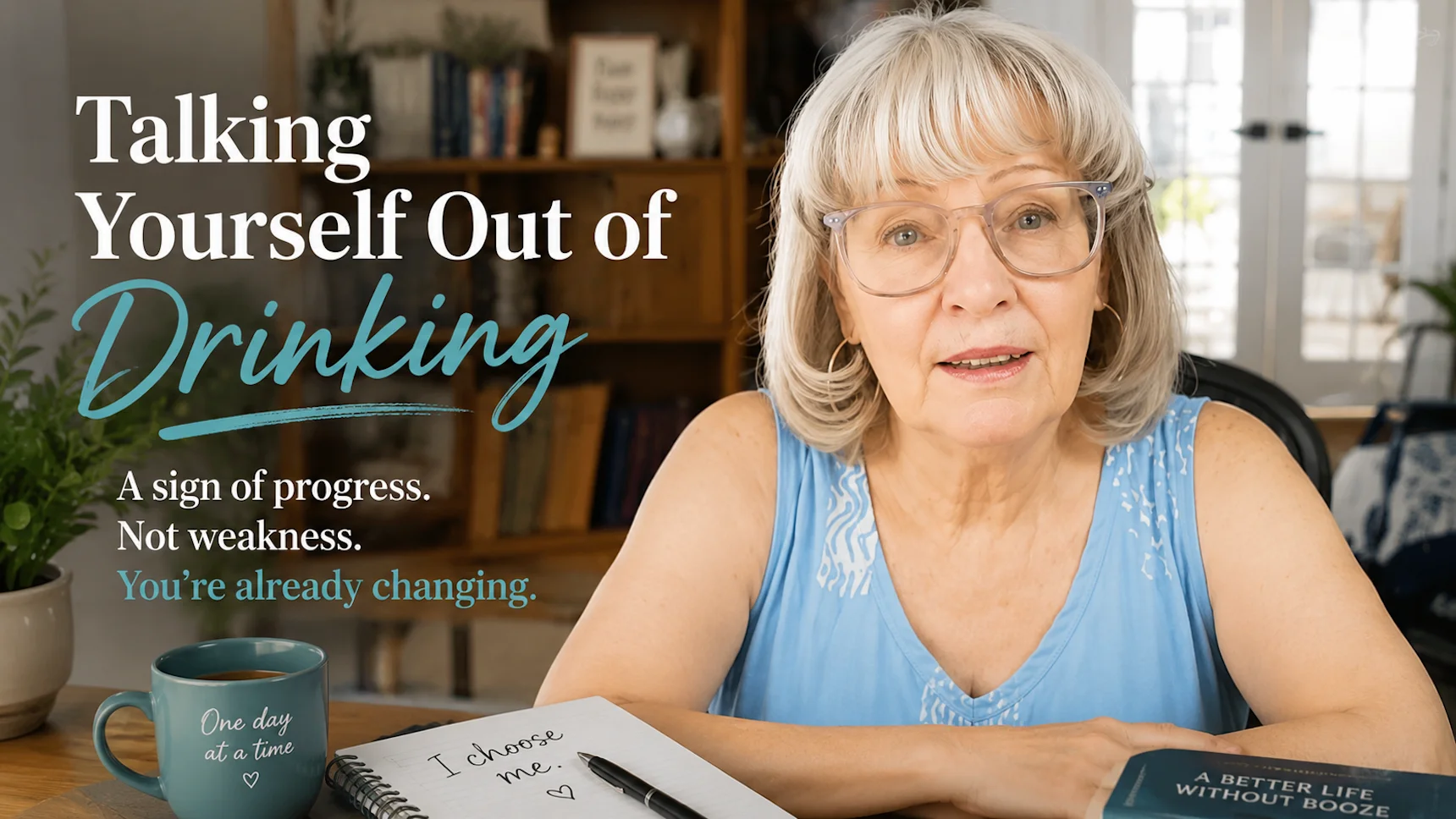
Talking Yourself Out of Drinking

Written by Susan — Quit drinking at 37 • Sober since 1998 • Sharing what actually works
Written by Susan — Quit drinking at 37 • Sober since 1998 • Sharing what actually works
This morning, you decided you weren't going to drink tonight, and you meant it. Evening arrives, and now you find yourself in the position of talking yourself out of drinking.
One minute you're determined to stick to your plan, and the next you're making excuses to have a drink. Once you quieten that thought down (because that's all it is at the moment — a thought and not an action), you can breathe a little easier.
✅ Quick Answer: Is talking yourself out of drinking normal?
Talking yourself out of drinking is normal and is often a sign that you've started questioning alcohol's role in your life. Although the urge may keep returning, that internal debate can be an important first step toward change. Learning how to strengthen your decision and handle urges can make it easier to stay on track.
It's a frustrating back-and-forth conversation that many people experience in the early days of changing their drinking habits.
The good news is that this internal debate is completely normal. It doesn't mean you're weak, lacking willpower, or failing. The fact that you're talking yourself out of drinking at all may be a sign that something important has started to change.
Talking Yourself Out of Drinking Is a Sign of Progress
For years, I never tried talking myself out of drinking. I simply drank.
I didn't question it. Alcohol was part of my routine, and I accepted it without much thought. Over time, though, a niggling question started appearing:
"Am I drinking too much?"
Only you can answer that question for yourself.
But the moment you start asking it, something important has happened.
You've become aware.
That awareness is often the first real step toward change.
It's not always comfortable. In fact, it can be a bit scary. Up until now, you've been going about your life as usual, perhaps promising yourself in the morning that tonight will be different, only to find yourself drinking again by evening's end.
When the urge hits and you begin talking yourself out of drinking, that's amazing.
Why?
Because it means you've started questioning alcohol's role in your life. You're no longer accepting it automatically. You're beginning to ask whether alcohol is really the friend you thought it was.
Many people see this internal struggle as a sign they're losing.
I see it differently.
The struggle itself often means a new way of thinking is beginning to emerge.
Why the Internal Debate Keeps Coming Back
Here's how the thinking goes:
You decide not to drink. An hour later the urge to drink appears and you dismiss it. Right now, it's not hard to dismiss because your resolve is at its strongest.
Half an hour later it returns. Then the excuses start.
- "I've had a stressful day."
- "One won't hurt."
- "I feel better than I did yesterday."
- "I'll start again tomorrow."
I know firsthand how frustrating and exhausting this can feel. I lived it for half of my drinking life, which spanned twenty years. The latter ten years of nightly drinking — and lapsing — often began with that same annoying internal battle.
For a long time, that little voice usually won.
But looking back, I can see something important was happening.
The fact that the debate existed at all meant I was no longer drinking automatically. Part of me had started questioning whether alcohol belonged in my life, even if I wasn't ready to admit it yet.
The Decision Has Been Made, But It Hasn't Taken Root Yet
Even though we genuinely make the decision not to drink tonight, the urge can still appear seemingly out of thin air.
The decision has been made, but it hasn't had time to germinate yet. Like a newly planted seed, it needs time to develop roots. The idea of quitting drinking is still in its infancy, so naturally it's a little fragile.
That doesn't mean the decision is wrong. It doesn't mean you've failed. It simply means your new way of thinking hasn't had enough time to grow stronger than the old habit.
The old saying, "Time heals all wounds," is kind of applicable here. Time gives you strength. It also gives you proof. Proof that you can get through an urge without acting on it. Proof that you can interrupt the autopilot response that has been running for years.
And it all starts by learning how to tame the urge rather than obey it.
Using Somatic Marker Moments to Strengthen Your Decision
I want to share with you how I eventually tamed the drinking beast.
For me, it all goes back to January 17, 1998. Read that story and then come back here.
Having suffered through that agonizing morning, I was ready when the urge to drink reared its ugly head again. I had my somatic marker moments ready to go. They became my armor.
The moment I started thinking about having a drink, I remembered how ill I had felt. I remembered the fear, the misery, and the regret.
I thought:
"No way am I putting myself through that again."
And just like that, the urge lost its power.
A few days later, the devilish urge reappeared.
Once again, I reached into my somatic marker memory bank and brought forward another painful drinking experience. Once again, I reminded myself why I had made the decision to quit.
And once again, the urge backed down.
Over time, something interesting happens. The urges begin to weaken. They stop showing up quite so often. When they do appear, they don't seem quite so convincing.
Why?
Because you've stopped automatically believing everything they tell you.
You've learned how to quieten them.
What to Do When the Urge Shows Up Again
Many people find that taking a walk or making a cup of tea breaks the cycle long enough for the moment to pass.
Others read a book, listen to a podcast, call a friend, or simply change their environment for a while.
This is also an excellent time to review your somatic marker moments. If you haven't already, grab a copy of the workbook above. Use it to remind yourself why you made the decision not to drink in the first place.
Remember this:
An urge is an urge is an urge.
It isn't an action.
Not yet.
Before the urge reaches the urge stage, it often begins as a wistful memory. You remember relaxing with a drink in your hand. You remember the anticipation. You remember what you believe alcohol is going to give you.
Then the thought grows stronger.
The urge appears.
And that's when you bring forward one of your somatic marker moments.
You remember the hangover.
- The regret.
- The embarrassment.
- The anxiety.
- The promises you made to yourself.
Suddenly the urge doesn't seem nearly as convincing.
The thought passes.
The urge passes.
And that's a beautiful thing.
Give Your New Decision Time to Grow
I remember feeling relief about three months into my sobriety. Relief that I wasn't automatically reaching for a glass of booze; relief that I was getting better physically and mentally. Relief that I wasn't becoming a slave to the bottle (as my dad would say).
Talking yourself out of drinking will become easier over time, and eventually you won't need to have that conversation with yourself nearly as often.
The seed has been planted and now it needs time to grow.
Every time you quieten an urge instead of obeying it, you're proving to yourself that you can do it... again.
The goal isn't perfection.
The goal is giving the new decision enough time and repetition to become stronger than the old habit.
And remember, the fact that you're talking yourself out of drinking at all means part of you already wants something different. That's worth paying attention to.
Continue Exploring Shame-Free First Steps
If you've started questioning your relationship with alcohol, you're already taking an important first step. These articles are designed to help you move forward without shame, pressure, or labels. Explore practical guidance, gentle encouragement, and real-life insights that can help you build confidence one sober decision at a time.
→ Browse all Shame-Free First Steps articles
Ready for More Support?
Explore Live Better Sober: Quit Drinking — Break the Alcohol Habit, a practical, shame-free 66-day course designed to help you recognize and interrupt the pattern behind your evening drinking.
➡️ Learn more about the course here: Break the Nightly Drinking Habit
Shame-Free First Steps
Quietly Stopping Drinking at Home
Quietly stopping drinking at home is possible for many people. Learn practical first steps, safety considerations, and how to begin.
I Already Poured a Drink. Now What?
I Already Poured a Drink. Now What? If you haven't taken a sip, learn how to pause, interrupt, and change course tonight without regret.
How Tomorrow-Me Thinking Can Help You Stay Sober Tonight
Tomorrow-me thinking is a simple way to talk yourself out of drinking tonight by focusing on how you'll feel when you wake up tomorrow.
What to Say Back to “I Deserve a Drink”
What to say back to “I deserve a drink” when the thought is defending a familiar habit loop and trying to pull you back into drinking.
Sober Curious First Steps: Where to Begin
Sober curious first steps for women wondering if it's time to rethink nightly drinking without pressure, shame, or labels.
Alcohol-Free Evening Starter Routine
Alcohol-free evening starter routine to help you replace nightly drinking with a calming habit that actually sticks.
2-Minute Walk in the Door Reset
What's a 2-minute walk in the door reset to interrupt autopilot pouring? How to interrupt the habit before you reach the fridge.







I'm Susan, creator of Live Better Sober, and in January 2028 I'll celebrate 30 years alcohol-free.
Everything on this site comes from my own experience.
I hope that by sharing what I've learned, I can help you break the nightly drinking habit, rediscover yourself, and live better sober, too.
I'm Susan, creator of Live Better Sober, and in January 2028 I'll celebrate 30 years alcohol-free.
Everything on this site comes from my own experience.
I hope that by sharing what I've learned, I can help you break the nightly drinking habit, rediscover yourself, and live better sober, too.
Stay Connected with Live Better Sober
Get new articles, personal stories, podcasts, and practical ideas to help make sober evenings easier.
No lectures. No labels. Just useful support from someone who's been there.


NEWSLETTER
HOME ABOUT CONTACT DISCLAIMER PRIVACY TERMS
FOLLOW US ON:



|
|
|
|
|
SEARCH THIS SITE
LIVE BETTER SOBER IS BASED ON SUSAN GAST'S PERSONAL EXPERIENCE WITH QUITTING ALCOHOL AND LONG-TERM SOBRIETY.
ALL CONTENT COPYRIGHT © 2026 LIVE BETTER SOBER BY SUSAN GAST • ALL RIGHTS RESERVED REGARDLESS OF LINKS OR ATTRIBUTIONS.
POWERED BY SBI! (SOLO BUILD IT!)
